 Nederlands
 Deutsch
 Español
  Français
 Русский
Hollywood Style Vanity Mirrors: Demystifying Bulk Pricing, MOQs, and Lead Times for B2B Importers
Navigating the global sourcing landscape for commercial-grade lighting fixtures requires a deep understanding of manufacturing economics, quality control tolerances, and supply chain logistics. For B2B importers, distributors, and procurement managers, purchasing a Hollywood Mirror in bulk involves balancing structural customization against production lead times and Minimum Order Quantities (MOQs). This guide analyzes how manufacturing choices directly dictate wholesale pricing tiers, factory operational workflows, and overall landing costs.
1. Raw Material Specifications and Cost Drivers
In our production line, the primary driver of unit cost is the raw material grade of the glass substrate and the outer frame chassis.
Standard retail mirrors often utilize cheap 2mm glass, which is highly prone to distortion and shattering. During factory audits, we have found that premium B2B applications require a minimum of a 3mm Aluminum Mirror or a 5mm silver mirror to guarantee optical clarity and structural integrity. For example, our Model DP330-XL features a 3mm Premium Aluminum Mirror that undergo strict CNC cutting and edge-polishing routines to eliminate micro-fractures before assembling the final product.
Beyond the glass, the reflective coating is critical. Low-grade mirrors utilize a single-layer aluminum backing, whereas professional-grade vanity products utilize double-coated silver backing with a protective copper-free layer to prevent oxidation and black-edge corrosion. This copper-free backing successfully passes the industry-standard 120-hour salt spray test, confirming long-term durability in high-humidity environments. Frame materials also impact costs; cold-rolled steel with electrostatic powder coating or extruded aluminum frames offer superior structural stability compared to injection-molded ABS, though the latter is highly cost-effective for smaller desktop mirrors.
2. Electrical Safety Standards and Luminaire Compliance
Sourcing electronic products for international markets requires strict adherence to regional safety standards. Incorporating multi-bulb arrays requires careful electrical load balancing and driver matching to prevent premature component failure.
Our manufacturing facility ensures all electrical components comply with major international standards. To mitigate electromagnetic interference (EMI) caused by dimming circuits, our integrated LED drivers comply with FCC Part 15 and CE-LVD requirements. Furthermore, our complete assembly lines are audited to satisfy CE standards, ensuring safe deployment in commercial spaces.
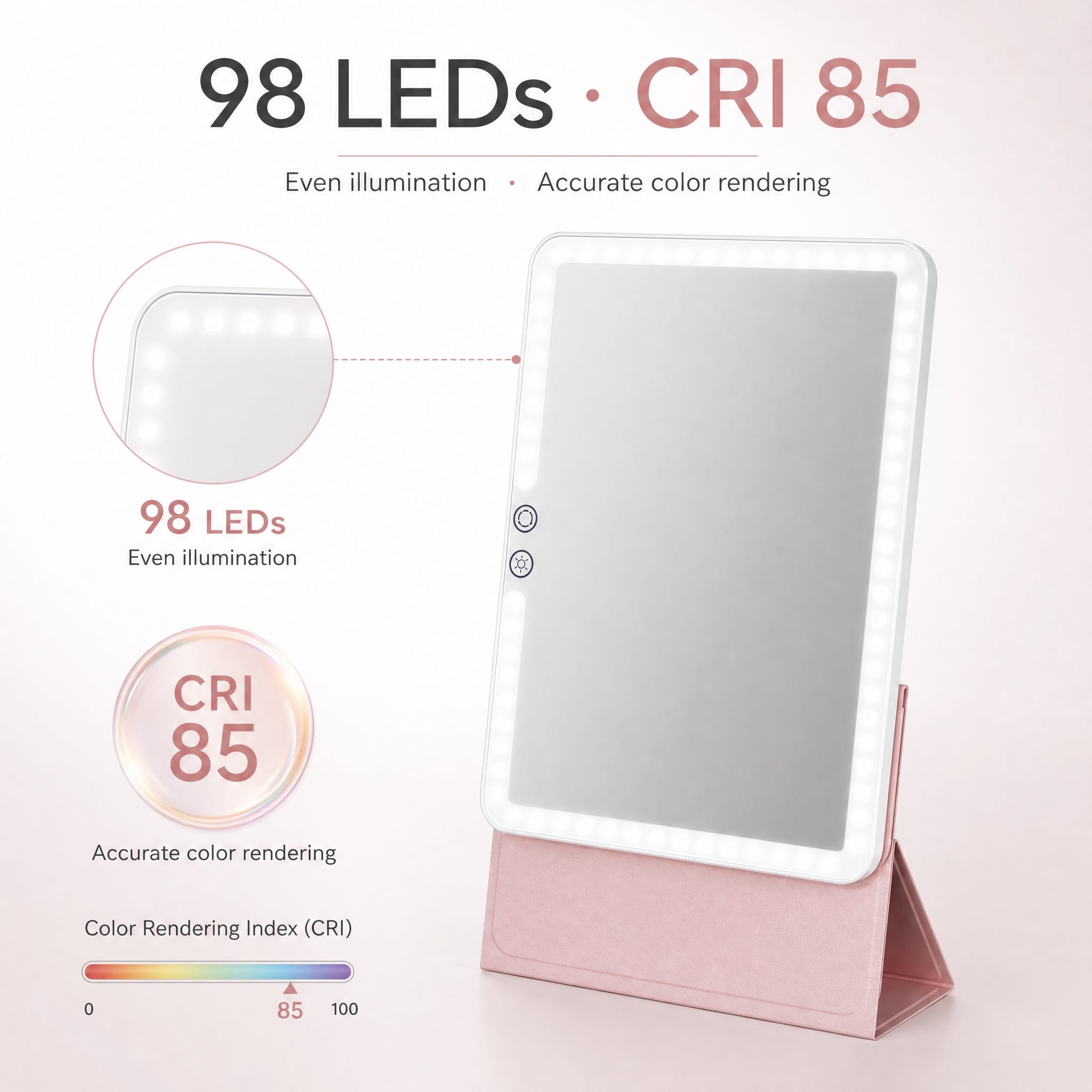
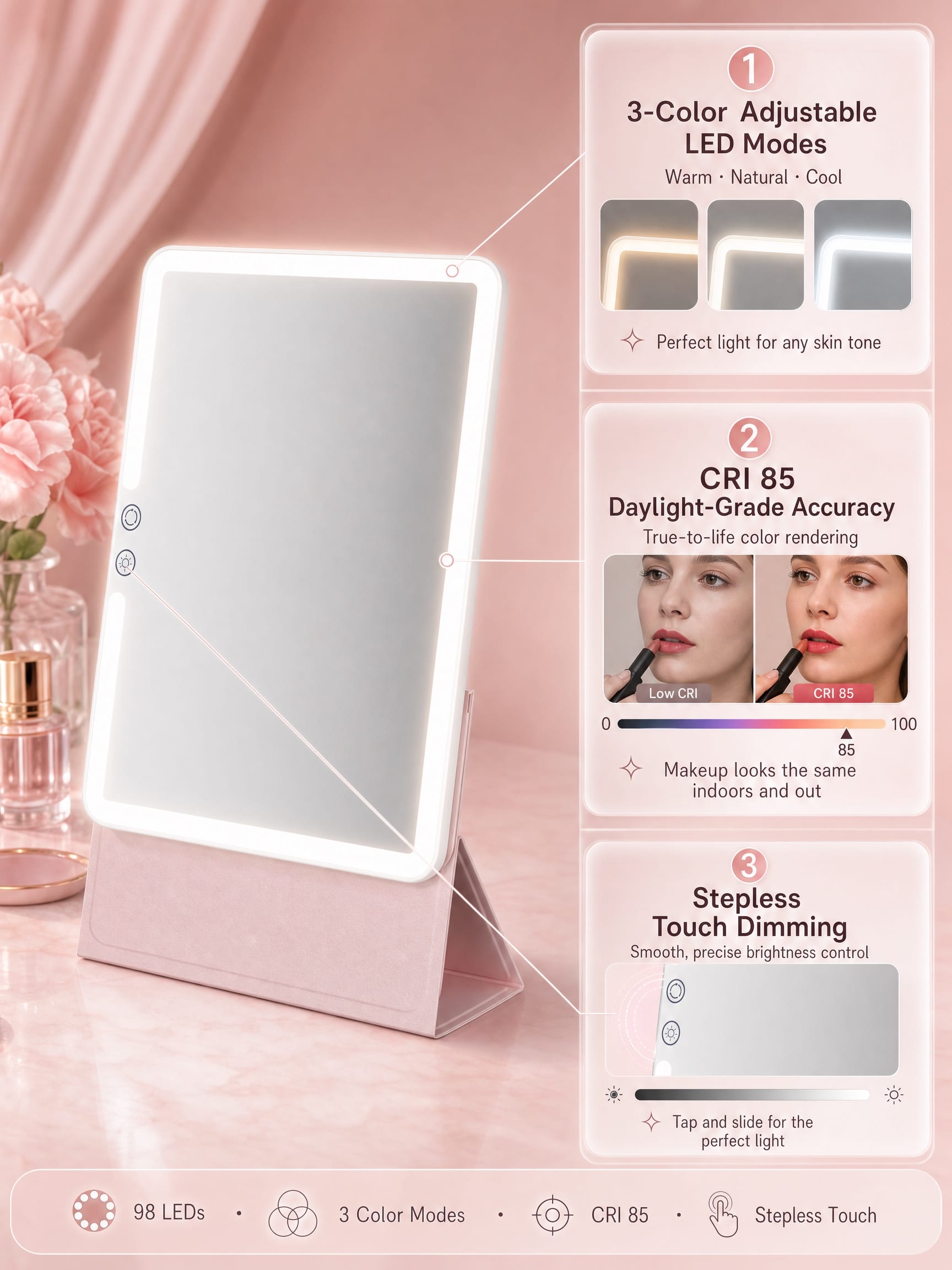
For optimal color rendering, LED modules must be calibrated correctly. Standard bulbs often exhibit low color accuracy, whereas premium commercial models provide a Color Rendering Index (CRI) of over 90. This level of quality is present in our Model RM601, which features professional 3-color LED lighting (warm, natural, and cool light) with high-density LED strips (such as 120 LEDs/m) to eliminate shadow gaps on the user's face.
3. Demystifying MOQs and Sourcing Customizations
Minimum Order Quantities (MOQs) are dictated by factory setup costs and raw material supplier minimums. For standard catalog items, the factory MOQ typically ranges from 100 to 200 units. However, introducing premium customizations like integrated Bluetooth modules, touch-screen controls, or custom frame finishes alters these thresholds.
When a client requests a Bluetooth Hollywood Mirror, the MOQ is driven by the specialized PCBA manufacturing run, which usually requires 500 units to amortize the engineering and programming costs. Similarly, custom powder-coated frame colors require dedicated paint-line cleanouts and color calibration runs, pushing the MOQ to 300 units per color. Understanding these constraints allows importers to optimize their procurement budgets and align product offerings with target retail or hospitality projects.
4. Production Lead Times and Supply Chain Bottlenecks
From manufacturing thousands of units, we have established a standard lead-time structure that accounts for material sourcing, assembly, QC, and packaging phases. The typical lead time for a standard order of 500 units is 30 to 35 days from deposit confirmation. However, custom tooling or sourcing specialized components like custom-shaped glass or bespoke CNC frames can extend this timeline to 45 or 50 days.
To avoid delivery bottlenecks, importers must account for seasonal manufacturing peaks, particularly preceding the Chinese New Year or during the Q3 pre-holiday shipping rush. During these periods, glass factories and shipping lines operate at maximum capacity, often causing delays. Establishing rolling forecasts and booking container space 4 to 6 weeks in advance mitigates these risks, ensuring consistent stock availability for your distribution networks.
5. B2B Mirror Specifications and Logistics Optimization
The following table outlines the technical specifications, standard MOQs, and estimated manufacturing lead times across different tiers of the Vanity Mirror product line to assist in planning your next container-load shipment.
| Mirror Model / Tier | Key Technical Specifications | Standard MOQ | Lead Time (Days) | Target Landing Application |
|---|---|---|---|---|
| Model DP330-XL (Desktop Series) | 3mm Aluminum Mirror, 2835 Dual Color LED Strip (120 LEDs/m), 3-Button Touch Switch | 200 Units | 30 Days | E-commerce retail & compact desktop vanity programs |
| Model RM601 (Double-Sided Series) | Double-sided retractable, 1X & 7X magnification lenses, 3-color adjustable lighting | 500 Units | 35 Days | Professional makeup salons & luxury hotel bathroom fittings |
| Model SM476-SL (Precision Series) | Single-sided flat mirror with 10X spot mirror, matte flat lens, uniform 3-color lighting | 300 Units | 40 Days | Cosmetic retail displays & professional grooming centers |
6. Packaging Standards and Logistics Efficiency
Fragile items require robust packaging structures to withstand international shipping stresses. Our factory quality control standards dictate that all large-format vanity mirrors undergo and pass standard drop testing (ISTA 1A or 3A protocols) before leaving the factory. Packing configurations typically feature molded high-density expandable polystyrene (EPS) or polyethylene (EPE) foam, corner guards, and 5-layer corrugated outer master cartons.
For Full Container Load (FCL) shipments, we optimize palletization to maximize the volumetric efficiency of a 40HQ container, lowering the per-unit landing cost. Loose Less-than-Container Load (LCL) shipments require wood-crate reinforcement or heavy-duty pallet corner boards to prevent side-impact damage during multiple handling stages in transit hubs. Our QA protocols maintain an Acceptable Quality Limit (AQL) of 1.0 for major defects and 2.5 for minor defects, ensuring high-quality standard shipments arrive intact.
Frequently Asked Questions (FAQ)
Q: How do glass thickness and silvering quality affect wholesale pricing of Hollywood mirrors?
A: Glass thickness (e.g., 3mm vs. 5mm) and silvering quality directly influence the raw material cost. Thicker glass increases structural durability and reduces optical distortion over large surfaces. High-grade copper-free silvering prevents oxidation and dark spots under high-humidity conditions, which increases raw material costs by 15-25% compared to basic aluminum-coated glass mirrors.
Q: What are the standard lead times for custom-dimension Hollywood vanity mirrors in bulk orders?
A: Standard bulk orders of catalog items (e.g., 500 units) require 30 to 35 days. If custom dimensions or unique frame configurations are ordered, the lead time extends to 45 to 50 days to accommodate structural drafting, custom CNC glass-cutting setups, and paint-line color changes.
Q: How do manufacturers structure MOQs for Hollywood mirrors with integrated Bluetooth or USB ports?
A: Adding electrical components like Bluetooth speakers or USB charging outlets raises the MOQ to 500 units. This is due to the minimum production runs required by certified PCB manufacturers to assemble and test integrated circuits for compliance with FCC and CE standards.
Q: What are the packaging and palletization standards to prevent breakage during FCL/LCL transit?
A: We utilize ISTA 3A drop-test certified packaging, containing molded EPE foam buffers, reinforced protective edge protectors, and five-layer corrugated boxes. For LCL shipments, we recommend solid wooden crate packaging, whereas FCL containers are palletized and stretch-wrapped to prevent shifting during transit.
Q: Are LED bulbs in bulk Hollywood mirrors replaceable or integrated, and how does this impact unit cost?
A: We offer both configurations. Replaceable LED bulbs utilize standard E27 or E14 sockets, which lower maintenance barriers but can increase initial assembly and shipping volume. Integrated LED arrays, like those in our Metal Vanity Makeup Mirror products, offer a sleeker profile and lower shipping volume, decreasing landed transportation costs, though replacing them requires technical service or factory-provided replacement panels.





