 Nederlands
 Deutsch
 Español
  Français
 Русский
Manufacturing Standards for Hollywood Mirrors: Ensuring UL/CE Certification in Bulk Orders
For procurement managers and FF&E specialists, the selection of a Hollywood Mirror is not merely an aesthetic choice but a high-stakes technical decision. Importing electrical fixtures without rigorous verification of safety standards can lead to catastrophic project delays, failed site inspections, and significant legal liability. This guide outlines the necessary technical documentation and manufacturing rigor required to ensure global compliance for your next commercial order.
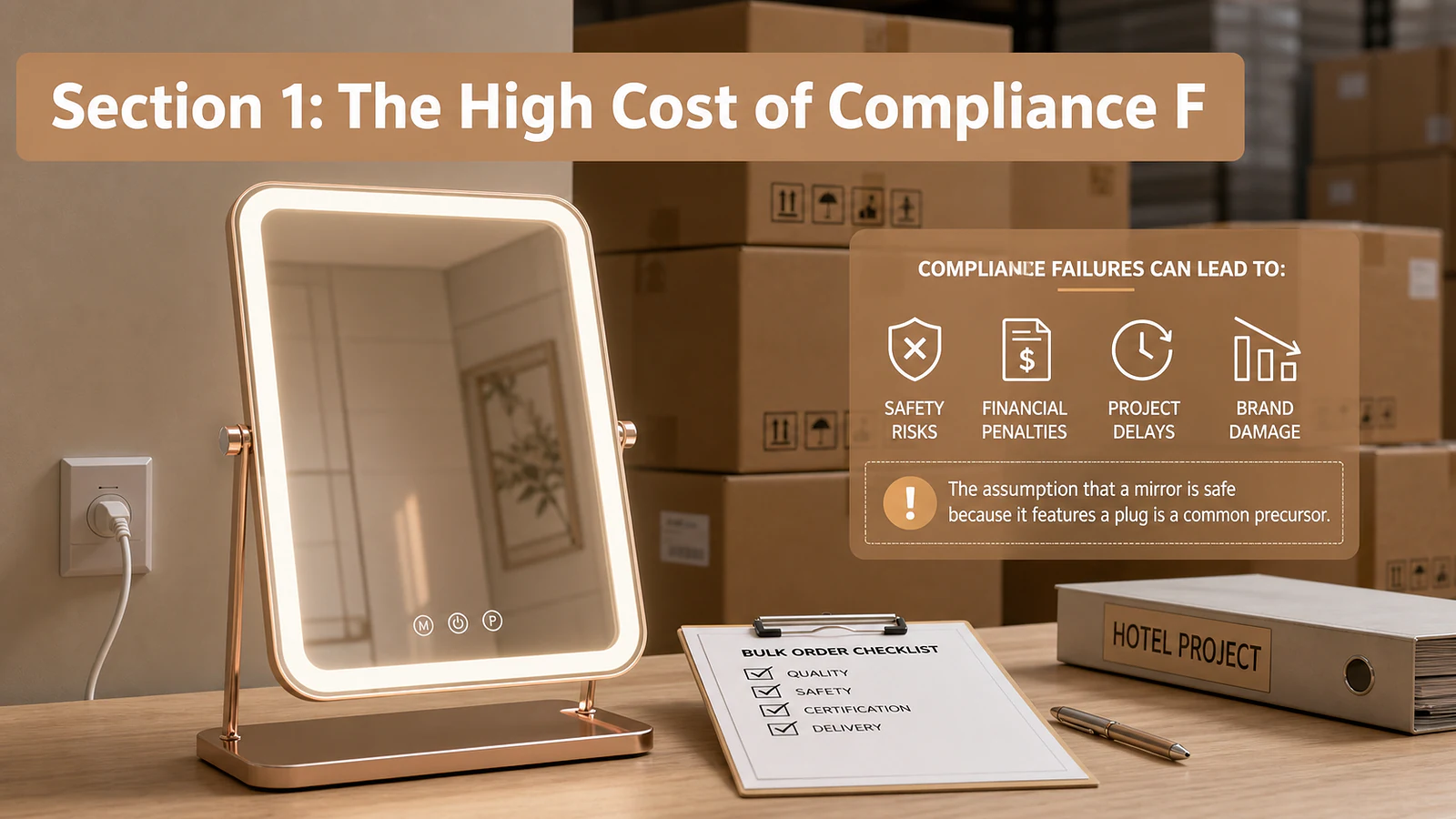
Section 1: The High Cost of Compliance Failures in Bulk Mirror Procurement
When supplying hospitality projects, the assumption that a mirror is safe because it features a plug is a common precursor to project failure. Local building inspectors demand proof that the entire assembly meets electrical safety requirements, not just the individual components. A non-compliant Large Hollywood Mirror can cause electrical arcs or overheating in high-traffic hotel bathrooms, leading to insurance claim denials and structural fire risks.
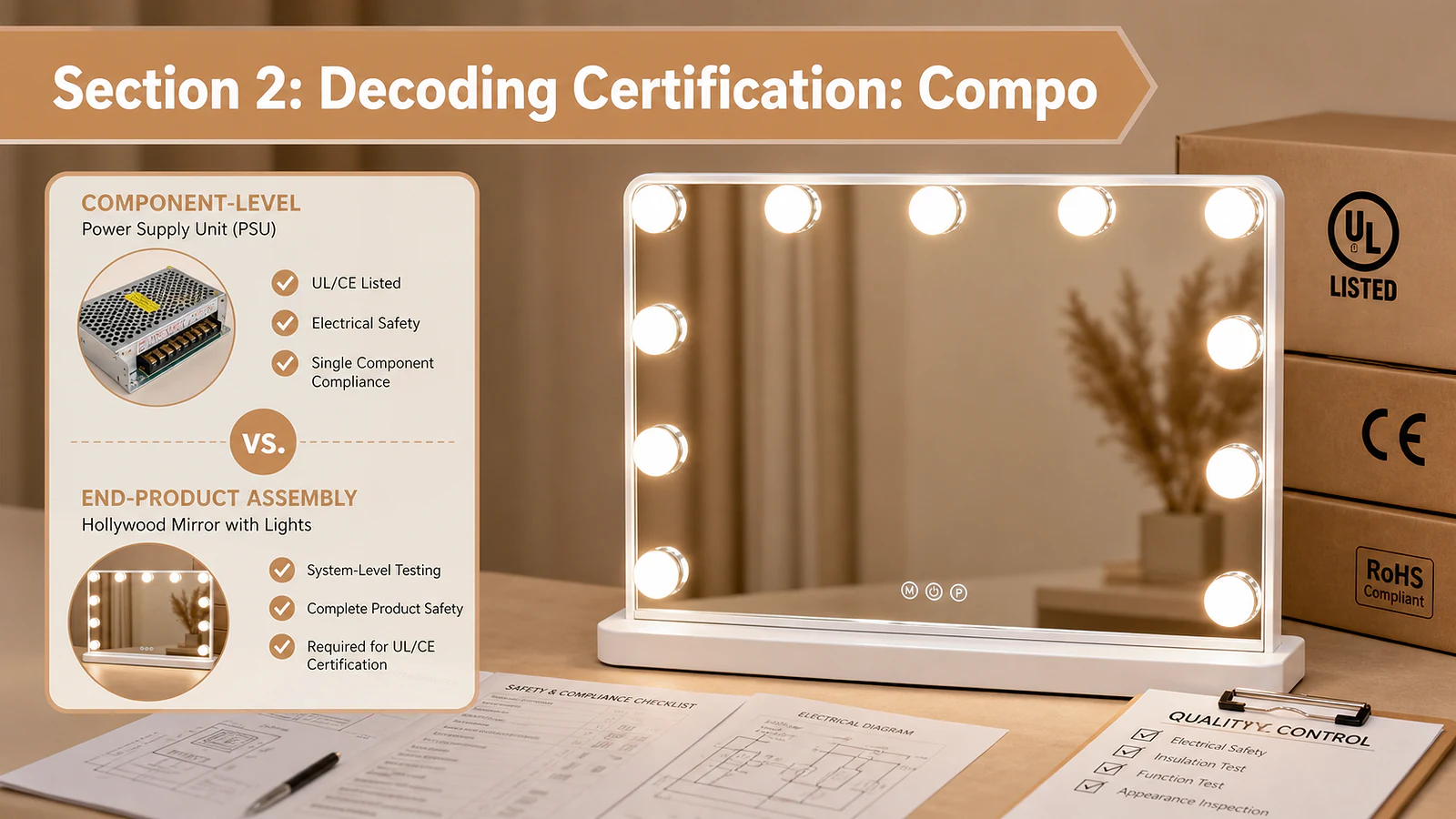
Section 2: Decoding Certification: Component-Level vs. End-Product Assembly

Many manufacturers mistakenly claim compliance based solely on the power supply unit (PSU). However, industry standards like UL 2108 for low-voltage lighting systems require that the entire fixture—including wiring harness, thermal management, and housing—is tested as a finished unit. In our production line, we distinguish between a 'UL-recognized component' and a full assembly certification. Relying on a CE-marked driver alone is insufficient if the enclosure design creates thermal stress on the LEDs during extended operation.
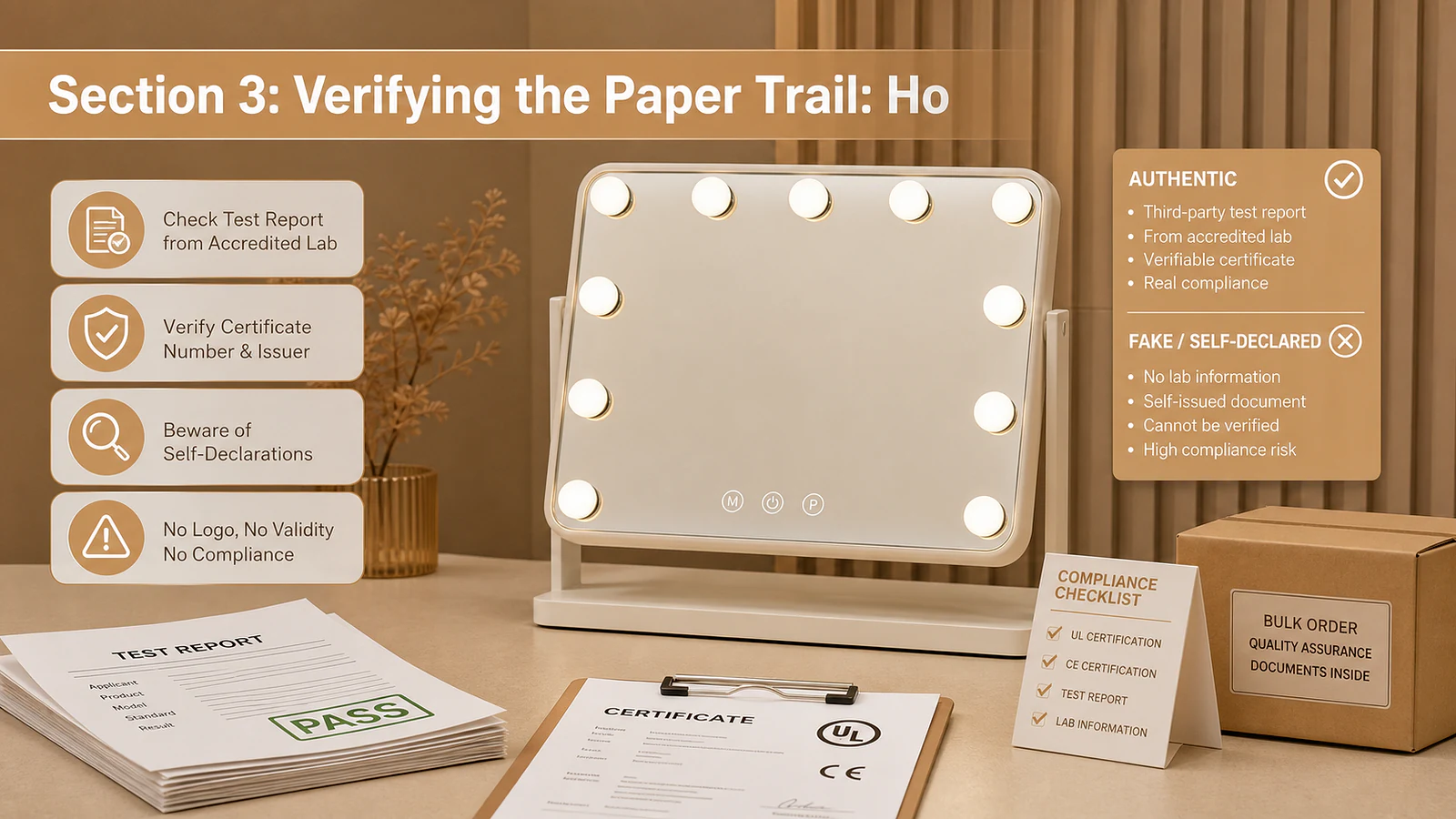
Section 3: Verifying the Paper Trail: How to Spot Fake Certificates and Self-Declarations
Buyers must distinguish between legitimate third-party laboratory reports and manufacturer self-declarations. Authentic CB Scheme reports provide global certification portability, confirming that the product has been audited against IEC 60598. During factory audits, we prioritize transparency by providing our Technical Construction Files (TCF), which outline the design criteria and raw material safety certificates for internal wiring components, ensuring full REACH and RoHS compliance.
Section 4: Technical Engineering for Safety: LED Thermal Management and Insulation Standards

Thermal degradation is the leading cause of premature failure in hospitality Bluetooth Hollywood Mirror units. Our engineering process utilizes aluminum alloy heatsinks to maintain junction temperatures below 60 degrees Celsius at full brightness. We implement dual-stage QC: first, verifying the PCB driver output before installation, and second, performing a 4-hour high-temperature electrical stress test on the fully assembled mirror to ensure no insulation breakdown occurs under prolonged usage.
Section 5: Transit Integrity: Ensuring Certifications Survive Shipping
A certified product is useless if it arrives damaged. Environmental protection is a component of safety compliance; moisture ingress due to improper sealing can render a fixture hazardous. We utilize moisture-resistant gaskets and drop-test packaging to ensure that internal wiring remains protected from condensation during maritime transit. Our container loading process involves a 10-point checklist, validating that every unit retains its IP rating post-shipment.
| Standard | Application | Criticality |
|---|---|---|
| UL 2108 | Low Voltage Lighting | High (North America) |
| IEC 60598 | General Luminaires | High (Global) |
| RoHS/REACH | Material Safety | Mandatory |
Section 6: The Manufacturer’s Checklist: What to Request Before You Sign
Ensure your procurement file includes: 1. Full CB Test Report for the final assembly. 2. Signed Declaration of Conformity (DoC) referencing current directives. 3. Detailed TCF (Technical Construction File) including wiring schematics. 4. QC test logs for the specific production batch. We invite you to request a consultation to verify these documents for your upcoming commercial project.
Q: Is a UL-listed driver sufficient for my bathroom mirror project?
A: No. While the driver is a critical component, the entire mirror assembly must be tested for electrical safety, including thermal management and grounding, to meet local installation requirements.
Q: How do I verify if a certificate is authentic?
A: Demand a CB report from the manufacturer. You can cross-reference the report number with the database of the issuing body (such as UL, TÜV, or SGS) to confirm its validity.
Q: What is the impact of IP ratings on my bulk mirror order?
A: In bathroom environments, improper IP ratings can lead to short circuits caused by humidity. Ensure your Vanity Mirror Customization includes specific IP44 or higher protection levels for electronic components.
Q: Why is thermal management crucial for LED vanity mirrors?
A: Excessive heat degrades LED lifespan and can melt plastic housing. Proper thermal engineering keeps the junction temperature low, ensuring the mirror remains safe for public, high-frequency usage.
Q: Can I use the same mirror certification for all global markets?
A: No. While CB reports offer broad utility, you must comply with regional overrides, such as specific voltage requirements (110V vs 230V) and local electrical codes in the destination country.


