 Nederlands
 Deutsch
 Español
  Français
 Русский
Selecting the Right OEM Vanity Mirror Manufacturer for Large-Scale Custom Projects
Procuring vanity mirrors for high-end hospitality or commercial projects requires a transition from off-the-shelf purchasing to an engineering-led manufacturing partnership. When sourcing for projects that demand high-quality aesthetics and reliable performance, understanding the technical differences between mass-produced catalog items and custom-engineered solutions is critical for success.
The Engineering Gap: Catalog vs. Custom OEM Vanity Mirrors
The primary pitfall for procurement managers is assuming that all mirrors with similar appearances share the same internal quality. In our production line, we see a distinct difference between white-label catalog products and custom-engineered units. While catalog mirrors rely on off-the-shelf LED strips and generic drivers, custom OEM production allows for the integration of industrial-grade components designed to handle specific high-duty cycles.
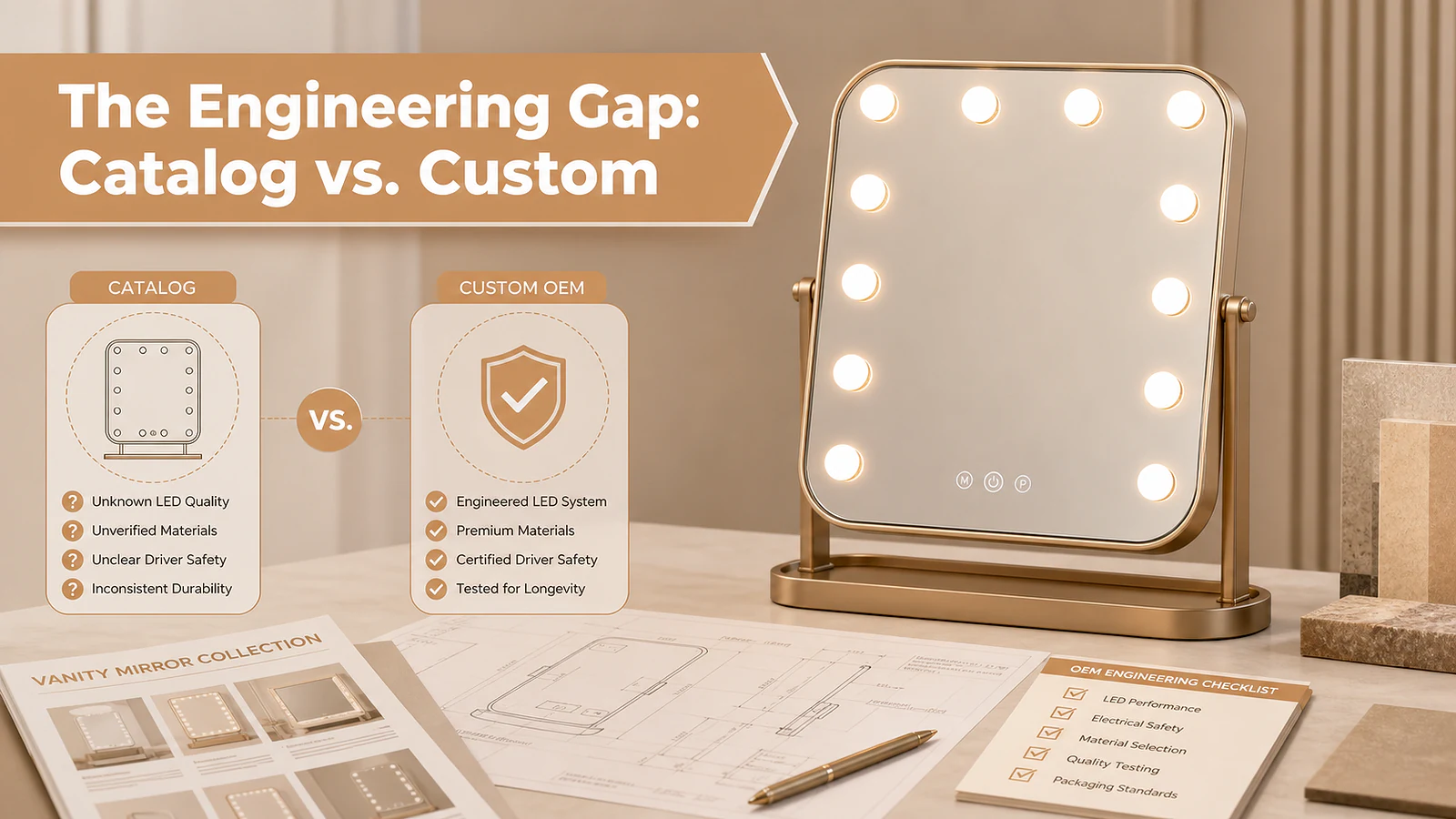
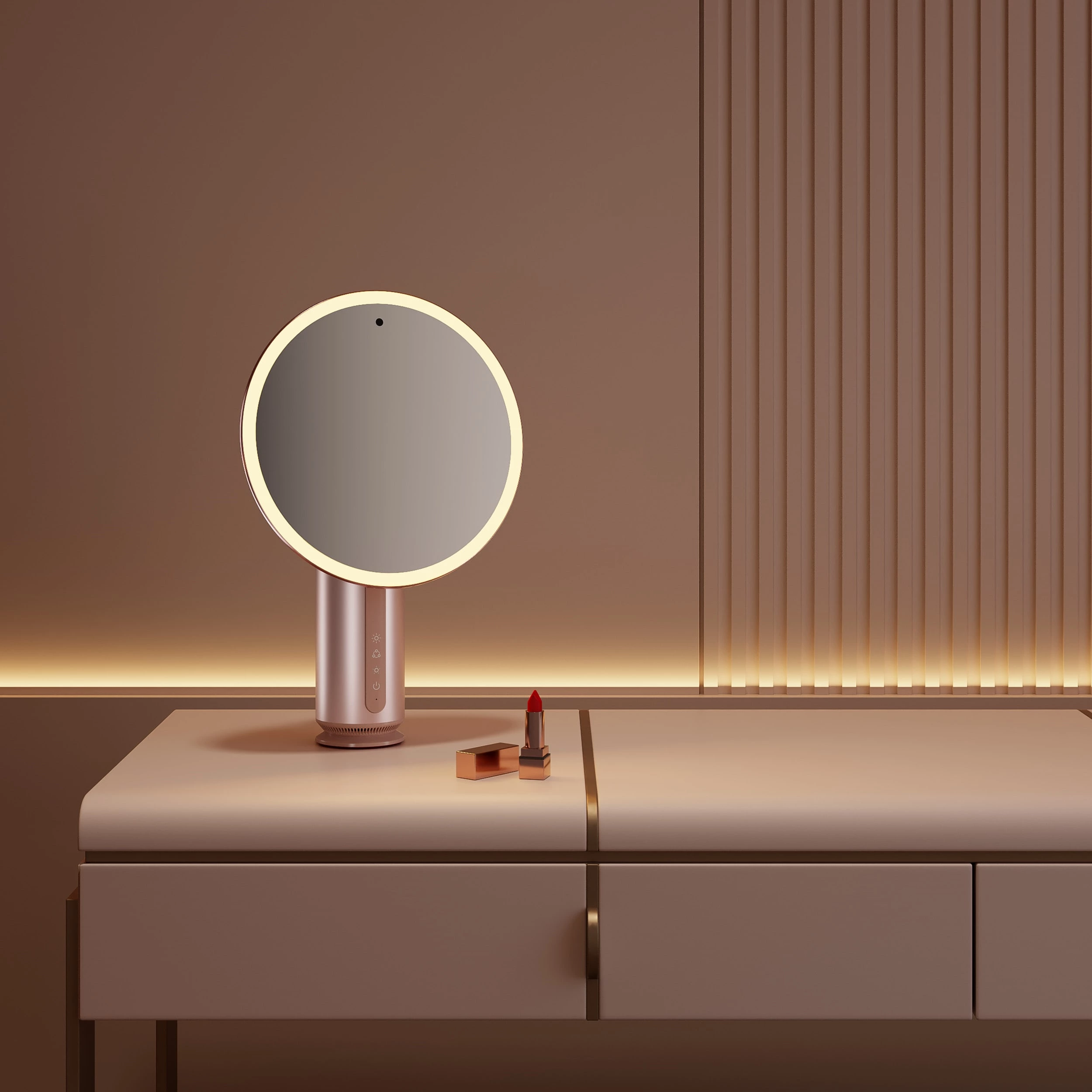
True Vanity Mirror Customization requires deep-level engineering. This includes specifying the exact glass thickness, the type of silvering for corrosion resistance, and the specific circuitry required for dimming protocols. Relying on catalog items often leads to inconsistent batches and higher return rates due to lighting failures in high-usage environments.
Mastering Light Consistency: How OEM Engineers Prevent Batch-to-Batch Color Shifts
Color temperature consistency is the hallmark of a professional-grade Hollywood Mirror. To prevent the common issue of batch-to-batch variation, we employ a proprietary binning process. This ensures that every LED module utilized across a large production run falls within a strict MacAdam ellipse of 3 steps or less, maintaining uniform light temperature throughout the entire project installation.
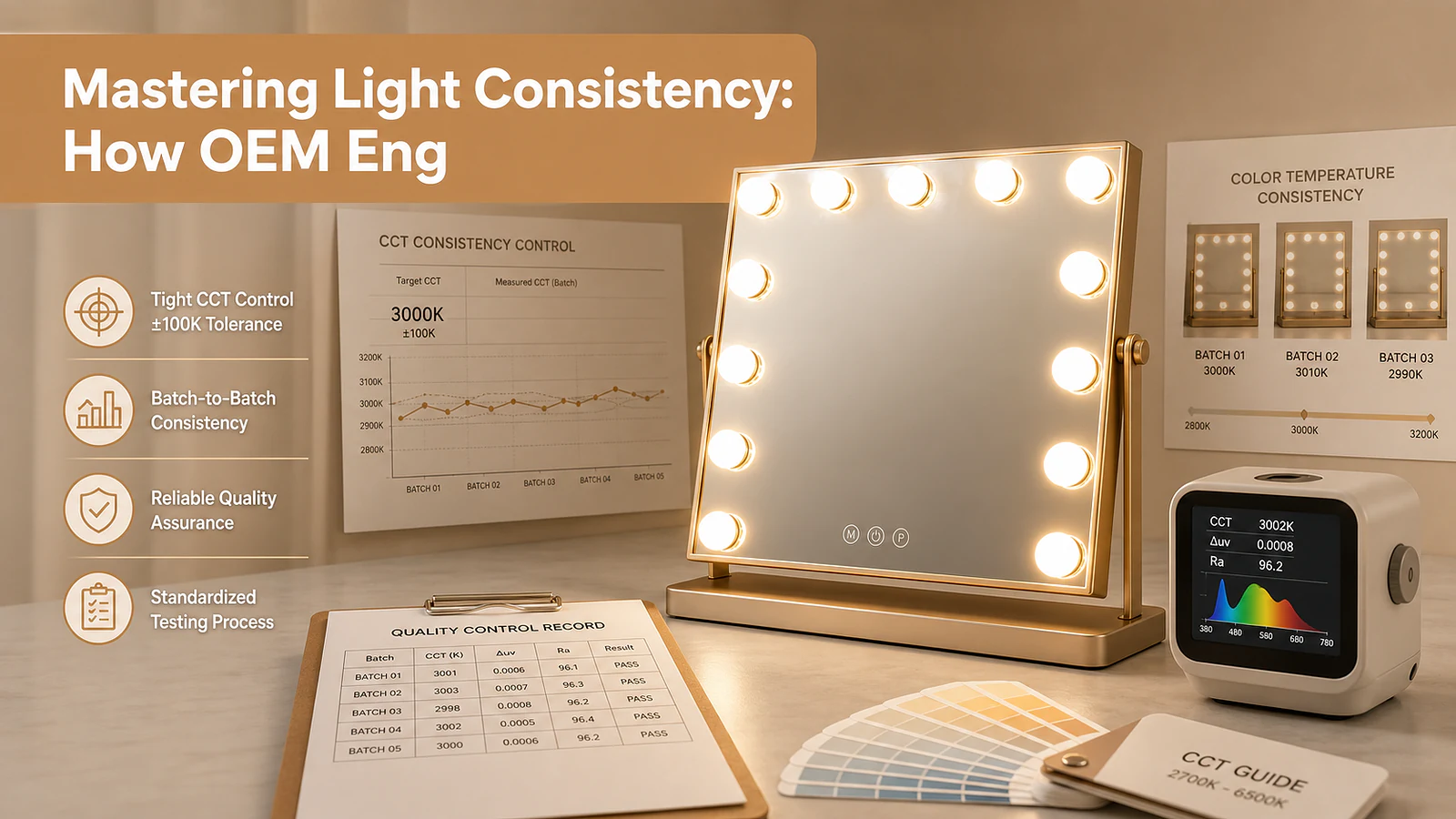
| Feature | Standard Catalog | Custom OEM Production |
|---|---|---|
| LED Binning | None/Random | 3-Step MacAdam/CRI >90 |
| Heat Management | None | Integrated Aluminum Heat Sinks |
| Safety Standards | CE only | UL/CE/RoHS Certified Systems |
Structural Integrity and Glass Technology: Beyond the Look
Mirror durability is non-negotiable for commercial hospitality. Beyond basic silvering, we conduct rigorous salt-spray testing to ensure our mirrors resist corrosion from humidity and cleaning agents. For impact resistance, we utilize 5mm tempered glass, which provides significantly greater structural integrity compared to standard 3mm annealed glass, adhering to safety standards required for public spaces.
Thermal Management: The Secret to LED Longevity in Vanity Units
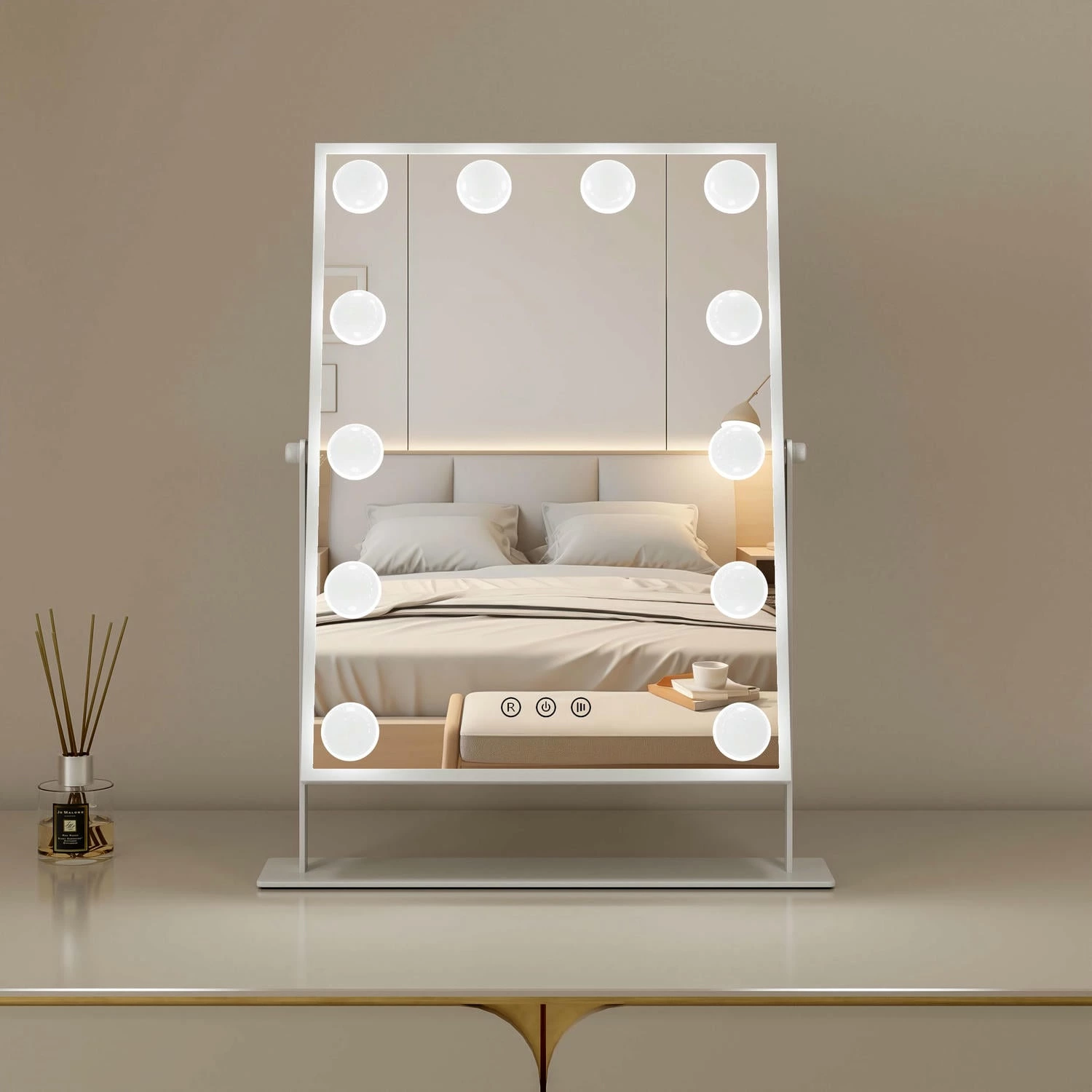
Heat is the primary enemy of LED light output. Our engineering team designs the internal architecture of every Metal Vanity Makeup Mirror with dedicated heat-dissipation pathways. By integrating aluminum profiles behind the light strips, we extend the lifespan of the diodes, ensuring that light output remains stable even after thousands of hours of operation. Similar to our industrial quality standards seen in high-elasticity fabric integration for other goods, we use precise material selection to ensure durability.
Quality Control Protocols for Bulk Vanity Mirror Orders
Managing large-scale production requires multi-stage inspections. We implement a QC protocol that involves checking 100% of the light output and circuit functionality before assembly. For example, our commitment to reliability mirrors the same rigor we apply to our high-elasticity products, such as model std01, where we use 20% Spandex for a secure fit. We document every phase of production, providing our partners with clear, actionable QC reports.
Compliance and Safety: Navigating Global Electrical Standards
Safety is the foundation of every mirror we produce. We ensure full compliance with international electrical codes, including UL 2108 and IEC 60598, to provide products that meet the stringent requirements of luxury residential projects and salons. Never assume universal compatibility; always verify if the drivers support local voltage requirements like 110V (North America) or 220V (Europe/Asia) before placing a bulk order.
Partnering for Profit: When to Move to Direct OEM Manufacturing
Transitioning to a direct manufacturing partner allows for greater project control and better ROI through economies of scale. By removing middle-men and engaging directly with an engineering-focused OEM, wholesalers and procurement managers can achieve a higher tier of product quality while maintaining strict budgetary control. Reach out to discuss how we can support your next luxury development with custom-engineered solutions.
Frequently Asked Questions
Q: What is the minimum order quantity (MOQ) for custom mirror projects?
A: While we offer flexibility, custom OEM projects involving bespoke sizing and lighting configurations typically start at 100 units per model.
Q: How do you ensure electrical safety in your mirrors?
A: All our lighting systems are tested against standards such as UL 2108, with integrated drivers featuring over-voltage and short-circuit protection.
Q: How is the consistency of light output managed across large batches?
A: We use LED binning (3-step MacAdam) and standardized driver calibration to ensure that every mirror in a shipment matches the color temperature of the prototype.
Q: Can you provide documentation for site inspections?
A: Yes, we provide full technical spec sheets, CRI measurement reports, and salt-spray test certifications upon request.
Q: What is the typical lead time for custom production?
A: After design validation and prototype approval, the typical lead time for production is 30 to 45 days, depending on order complexity and volume.


