Nederlands
 Deutsch
 Español
  Français
 Русский
Sourcing Illuminated Bathroom Mirrors: Understanding CRI, Lumens, and LED Lifespans
For commercial hospitality and multi-family residential developments, procurement of illuminated bathroom mirrors requires rigorous technical evaluation. Beyond simple aesthetics, long-term performance relies on the interplay of color rendering quality, actual luminous efficacy, and robust thermal management. This guide analyzes these key metrics through an engineering lens to help sourcing professionals minimize maintenance overhead and guarantee project satisfaction.
The Relationship Between CRI, R9 Values, and Lumen Efficiency
Color Rendering Index (CRI) is a critical metric for vanity applications, where accurate skin tone representation is essential. While a standard bathroom mirror might utilize LEDs with a CRI of 80, premium commercial installations specify CRI 90 or higher. Crucially, the standard CRI (Ra) calculation is an average of the first eight pastel colors, which excludes R9, the saturated red index. For accurate human skin tones and cosmetics application, an R9 value of 50 or above is necessary.
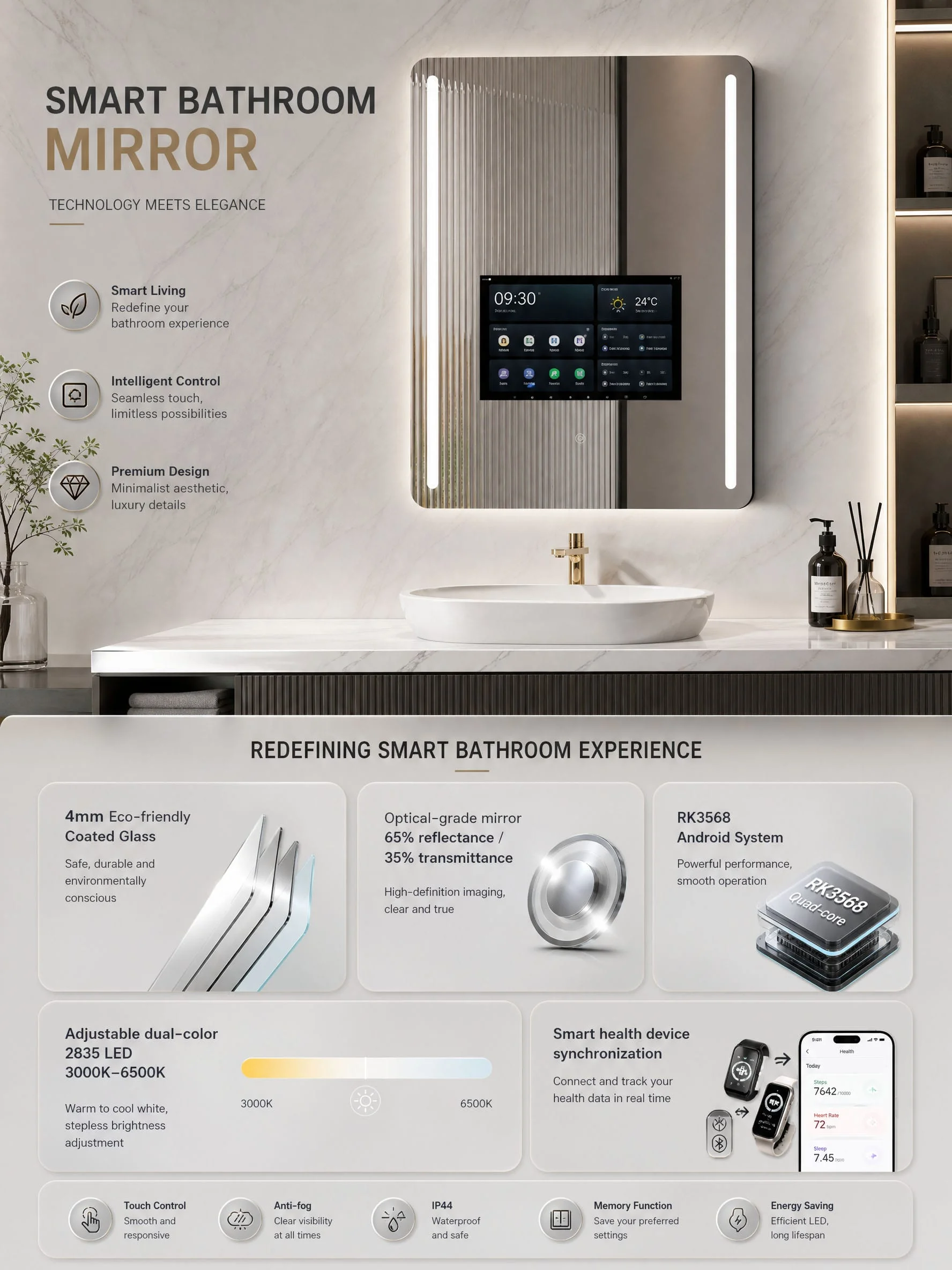
However, there is a physical trade-off between color rendering and luminous efficacy. To achieve a higher CRI, LED chips require more red-emitting phosphors, which absorb more blue light and reduce overall lumen output. When sourcing these products, engineers must account for this efficiency drop. Additionally, the mirrored glass itself—including the silvering layer and the frosted diffusion band—further reduces light transmission. A frosted band can absorb 30% to 50% of the raw lumen output, meaning the bare LED strip must be specified with higher initial lumens to deliver the required target illumination at the face of the mirror.
Calculating Lumen Requirements: Front-lit vs. Backlit Mirrors
Sourcing teams must differentiate between front-lit (direct task lighting) and backlit (ambient accent lighting) configurations to determine correct lumen specifications. Direct task lighting requires sufficient lux at the user's face, whereas ambient systems focus on wall illumination.
For a standard 24x36 inch frameless bathroom mirrors design, a front-lit configuration generally requires a minimum of 1,500 to 2,000 delivered lumens to replace or supplement overhead lighting. In contrast, a backlit mirror focuses on creating depth, typically requiring only 800 to 1,200 lumens. When custom integration is needed, a professional bathroom mirror customization process allows engineers to adjust the LED spacing, frosted width, and driver output to achieve precise photometric targets without over-specifying energy consumption.
Thermal Management and LED Driver Lifespans in Wet Environments
The primary point of failure in commercial illuminated mirrors is not the LED chips themselves, but the LED driver. High relative humidity and elevated temperatures within the mirror housing accelerate component degradation, particularly electrolytic capacitors inside the driver.
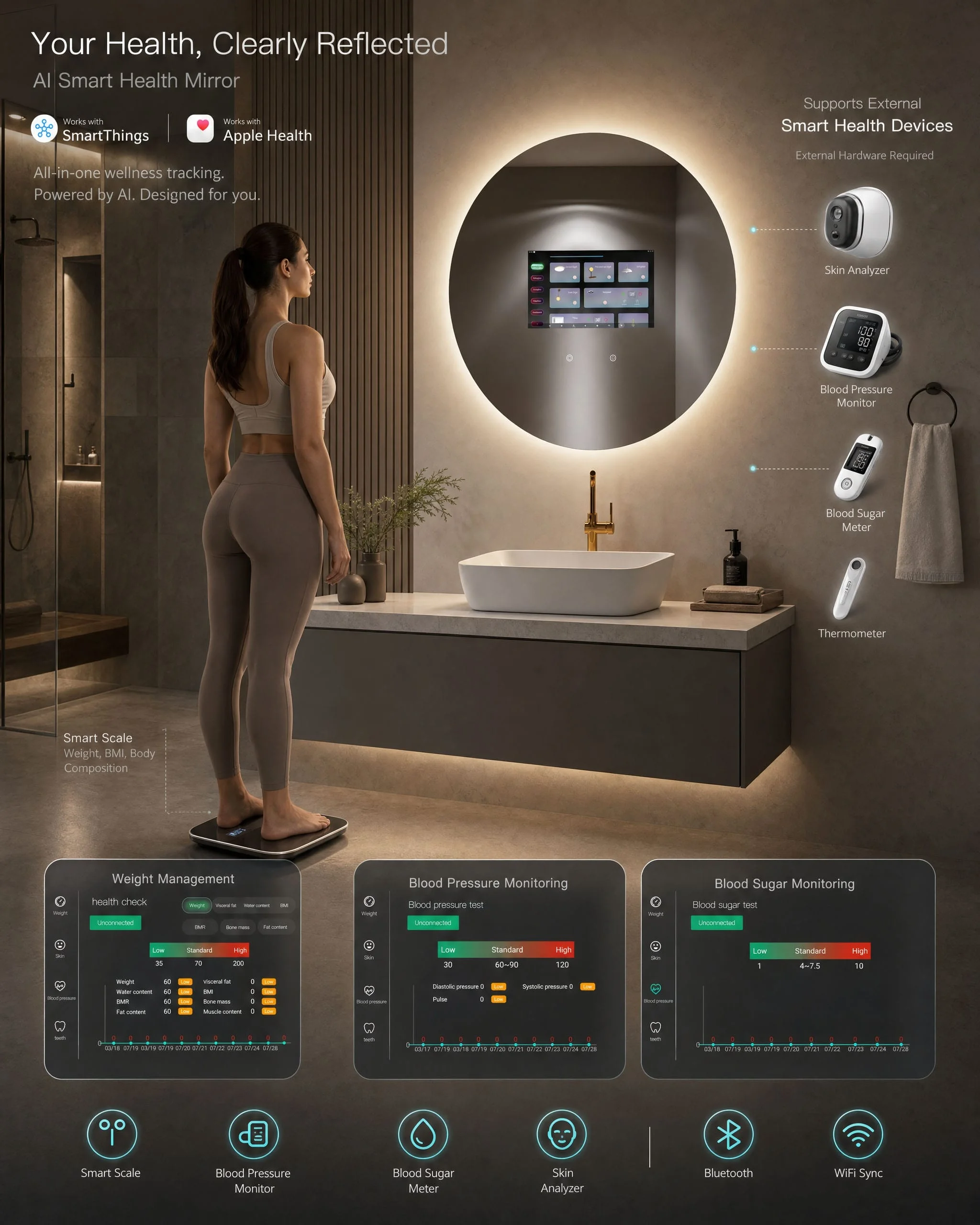
Robust thermal dissipation designs utilize aluminum back plates or dedicated metal clad printed circuit boards (MCPCB) rather than cheap FR4 substrates. A well-designed aluminum housing acts as a heat sink, transferring heat away from the driver and LEDs. For high-end hospitality projects, selecting a bathroom mirror cabinet with separated electrical compartments ensures that the heat generated by integrated electronics is isolated from the main LED array, maintaining driver temperatures well below their maximum rated operating limits.
Sourcing Performance Comparison
When comparing suppliers, evaluating technical data sheets rather than marketing claims is vital. The table below outlines key engineering differences between standard retail-grade mirrors and commercial-grade specifications.
| Technical Parameter | Retail-Grade Standard | Commercial-Grade Standard | Procurement Significance |
|---|---|---|---|
| Color Rendering Index (CRI) | 75 - 80 Ra (R9 unspecified) | 90+ Ra (R50+ R9) | Accurate skin tone and color representation |
| LED Lifespan Rating | L70 @ 25,000 Hours | L70 @ 50,000+ Hours | Halves long-term replacement/maintenance costs |
| Thermal Substrate | FR4 Plastic PCB | Aluminum MCPCB | Prevents localized overheating and color shift |
| Ingress Protection (IP) | IP20 or IP44 unsealed | IP44 - IP56 fully sealed | Protects components from steam and humidity |
Quality Assurance: L70 Lifespan Testing and Certification Standards
To verify supplier claims of a 50,000-hour operational life, sourcing agents should request LM-80 reports for the LED chips and TM-21 calculations for the overall system. The LM-80 standard measures lumen depreciation over a minimum of 6,000 hours at specified temperatures, while TM-21 provides the mathematical framework to project the L70 lifetime (the point at which light output drops to 70% of its initial value).
In high-humidity commercial bathrooms, continuous heat and moisture accelerate yellowing of the phosphor coatings and degradation of the optical adhesives. Sourcing premium solutions, such as an advanced Ai Tv Bathroom Mirror, requires verifying that both the display electronics and lighting arrays carry appropriate wet-location UL, CE, or SAA certifications to ensure long-term stability and electrical safety under daily thermal stress.
Sourcing and Technical Procurement FAQ
Q: What is the minimum CRI required for commercial hospitality bathroom mirrors?
A: The industry standard for commercial hospitality is a minimum of 90 CRI, with an R9 (red color rendering) value of at least 50. This ensures accurate skin tone rendition, which is critical for vanity and guest bathrooms.
Q: How do you calculate required lumen output for backlit vs. front-lit LED mirrors?
A: Front-lit mirrors require 1,500 to 2,000 delivered lumens to act as functional task lighting, factoring in a 30% to 50% loss through the frosted glass. Backlit mirrors, which provide ambient illumination, typically require 800 to 1,200 delivered lumens.
Q: How does thermal management in mirror housings affect LED driver lifespan?
A: Poor thermal dissipation raises the internal temperature of the mirror enclosure, causing the driver’s electrolytic capacitors to degrade rapidly. Utilizing aluminum backplates and isolating the driver within a ventilated chassis ensures components stay cool, extending driver life to match the LEDs.
Q: What are the industry standards for measuring L70 LED lifespan in high-humidity environments?
A: Manufacturers use LM-80 test data to evaluate LED chip degradation, coupled with TM-21 projection methods. These tests must run at high operating temperatures (typically 85°C and 105°C) to simulate long-term performance in humid, enclosed environments.
Q: How do LED degradation rates differ between continuous run and motion-activated commercial installations?
A: Continuous-run installations experience steady thermal loads, which can accelerate lumen depreciation if thermal design is poor. Motion-activated systems run cooler, extending the time to reach L70, but they require high-quality drivers designed to handle frequent on/off switching cycles without failure.