Nederlands
 Deutsch
 Español
  Français
 Русский
From Blueprints to Delivery: How Custom Bathroom Mirror Manufacturers Handle Large-Scale Commercial Bespoke Orders
Executing large-scale commercial bespoke mirror projects requires a seamless transition from engineering blueprints to high-volume manufacturing. For hospitality developers, high-end residential builders, and commercial distributors, partnering with an industrial-scale manufacturer guarantees that design intent aligns perfectly with structural integrity. This technical breakdown explores how premium factories manage complex production pipelines, minimize material risks, and ensure damage-free global logistics.
1. CAD/BIM Translation and CNC Precision Processing
The journey begins with the conversion of architectural CAD or BIM files into precise instructions for automated CNC glass cutting machinery. Commercial architectural plans often specify exact dimensions, but raw glass processing requires accounting for tolerances, bevel edge allowances, and hardware cutout clearances.
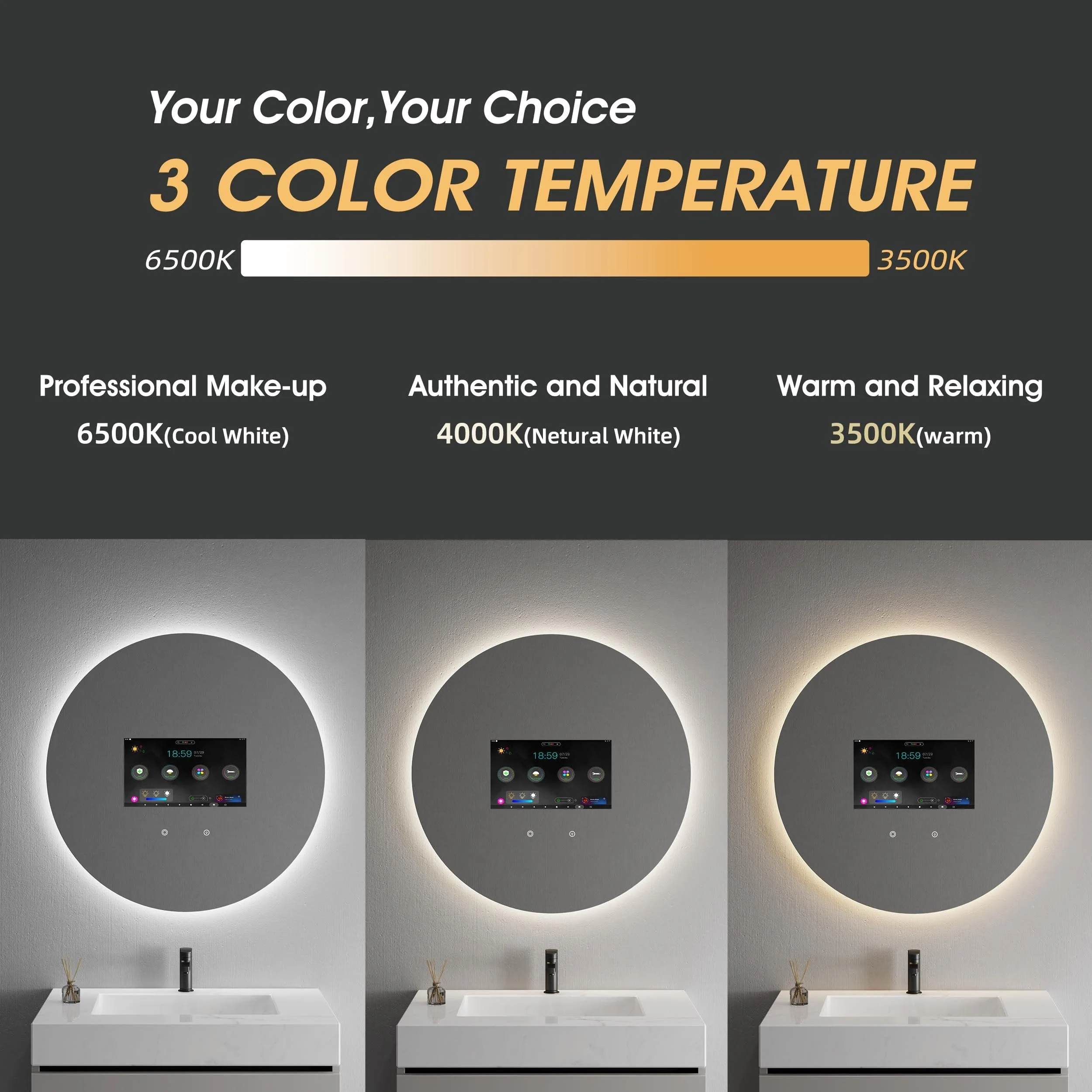
To guarantee dimensional accuracy across thousands of units, manufacturers utilize advanced glass optimization software that nests custom cuts to minimize waste. Once the digital blueprints are verified, the automated CNC glass cutting line executes the patterns, maintaining a strict tolerance of +/- 0.5mm. This extreme precision is essential for ensuring that complex geometries, such as those required for an irregular bathroom mirror, align perfectly with the surrounding wall cavities and mounting hardware on site.
2. Prototyping Approval Cycle and Mass Production Integration
Before launching full-scale manufacturing, factories initiate a strict prototyping phase to validate structural, optical, and electrical engineering details. A master physical prototype is fabricated and subjected to a battery of stress and function tests to uncover any hidden design flaws.
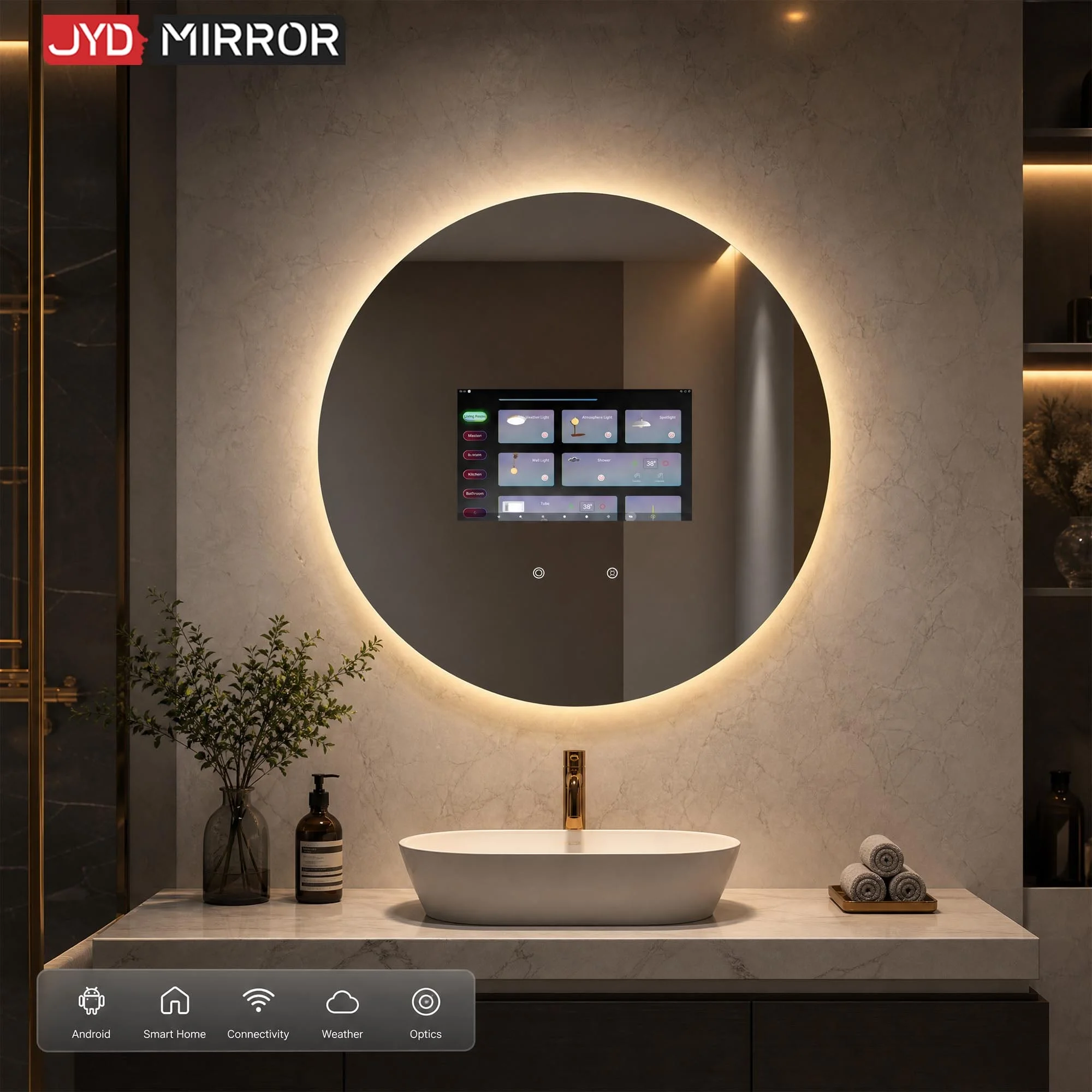
For complex installations, such as an integrated ai tv bathroom mirror, this step ensures that display modules, heat dissipation pathways, and touch sensor controls operate in harmony. Feedback from the client's engineering or architectural team is immediately integrated into the final CAD programming. This iterative review prevents costly delays down the line, locking in the precise BOM (Bill of Materials) and assembly sequence before the factory floor initiates continuous mass production.
3. High-Humidity Protection: Advanced Silvering and QC Checklists
Commercial bathrooms subject mirrors to constant humidity, fluctuating temperatures, and chemical exposure from cleaning agents. Standard mirrors are highly susceptible to black edge corrosion, which is caused by the oxidation of the silver reflective layer.
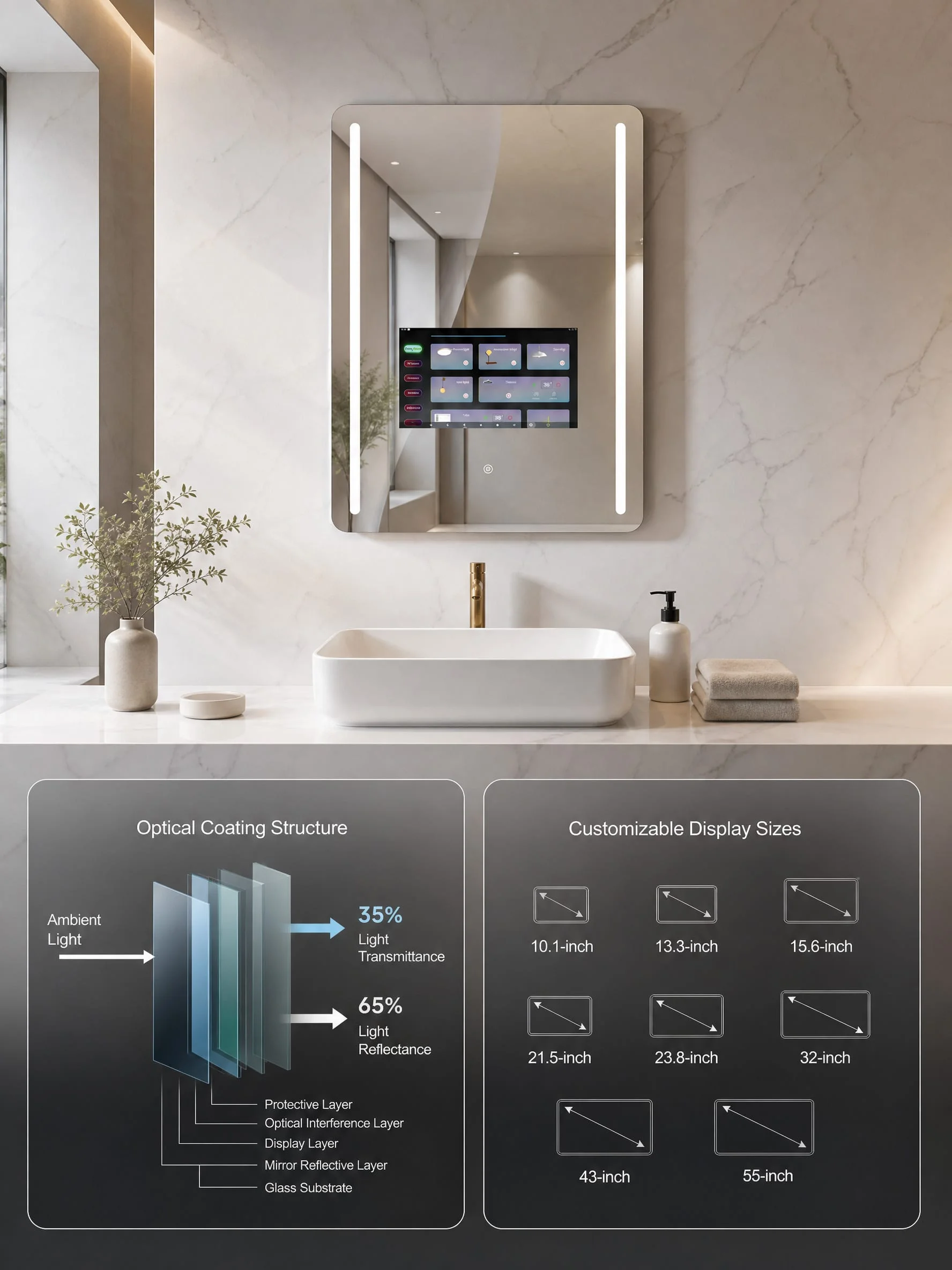
To combat this, professional manufacturers utilize premium copper-free, lead-free mirror glass as the default standard for any bathroom mirror customization project. The raw glass undergoes multi-layer protective coating, consisting of a pure silver reflective layer, a passivation barrier layer, and dual layers of waterproof protective backing paint. On-site factory quality control checklists mandate daily cross-cut adhesion tests, salt-spray chamber testing, and rigorous back-frame deflection testing to guarantee that the structural aluminum or steel backing remains stable under high load conditions.
4. Bespoke Component Supply Chain and Risk Management
Large-scale commercial orders introduce logistical complexity when sourcing specialized components like custom aluminum extrusions, specific color-rendering LED strips (CRI >90), or international-certified driver components. A disruption in a single component can halt the entire assembly line.
Industrial manufacturers mitigate this risk by maintaining long-term partnerships with certified secondary suppliers and stockpiling critical raw materials. Whether producing a modern frameless bathroom mirrors order or a highly customized backlit variant, the procurement team coordinates the arrival of extrusions and power supplies with the glass tempering schedule. This parallel workflow keeps assembly stations operating continuously without delays.
5. Logistics Risk Mitigation: Packaging, Staging, and Shipping
The manufacturing process is only successful if the product arrives at the job site intact. Shipping thousands of fragile, large-scale glass products across oceans and continents requires specialized industrial-grade packaging solutions.
For bulk commercial projects, finished products are placed in high-density foam edge protectors, wrapped in moisture-barrier film, and packed into individual reinforced cartons. These cartons are then staged and loaded onto custom-built heavy-duty wooden A-frame racks or fully enclosed plywood crates. This structural containment prevents shifting during transit, drastically reducing the risk of edge chipping and surface scratches during sea freight shipping and final site delivery.
Commercial Production Comparison
This comparison table highlights how a dedicated industrial manufacturer differs from a standard glass fabricator when processing complex commercial mirror orders:
| Production Parameter | Standard Glass Fabricator | Industrial Mirror Manufacturer |
|---|---|---|
| Dimensional Tolerance | +/- 1.5mm to 2.0mm (Manual) | +/- 0.5mm (Automated CNC) |
| Corrosion Resistance | Standard backing paint | Copper-free + dual-layer protective coating |
| Electronics Integration | Basic gluing, generic strips | UL/CE/SAA certified integrated back-frames |
| Bulk Logistics Packing | Standard loose pallets | Custom wooden A-frame crates & moisture-proof wrap |
Frequently Asked Questions
Q: How do custom mirror manufacturers guarantee dimensional accuracy across thousands of units?
A: Industrial factories utilize high-precision, automated CNC cutting and edging equipment driven directly by approved CAD/BIM files. Regular physical calibration of the machinery combined with on-line laser scanners ensures that every unit remains within a strict +/- 0.5mm dimensional tolerance margin.
Q: What is the typical lead time for custom back-lit LED mirrors in commercial quantities?
A: For bulk commercial orders, the typical production lead time ranges from 35 to 45 days. This includes CAD verification, prototype approval, metal back-frame extrusion processing, glass silvering, automated assembly, and strict electrical safety testing before container loading.
Q: How are large-scale fragile mirror shipments packaged and insured against transit breakage?
A: Mirrors are individually packed in drop-tested cartons featuring high-density foam edge protectors. For shipping, these cartons are loaded onto reinforced, ISPM-15 certified wooden A-frame racks or plywood crates. Shipments are also protected by comprehensive ocean transport insurance to cover any unexpected transit damage.
Q: What QA/QC steps do factories take to prevent silvering degradation in high-humidity commercial bathrooms?
A: Manufacturers exclusively use premium copper-free mirror glass protected by dual-layer waterproof backing paint. The factory quality control team regularly performs salt-spray chambers tests, adhesion tape tests, and humidity chamber cycling tests to verify the integrity of the protective barriers before the product leaves the facility.
Q: How does the shop drawing and prototyping approval cycle work for bespoke hospitality mirror orders?
A: The process begins with the client's design blueprints, which the manufacturer translates into technical shop drawings. Once the client approves these drawings, a physical prototype is produced to check dimensions, back-frame stiffness, and electrical components. Once this prototype is physically verified and signed off by the project manager, full mass production is officially scheduled.