Nederlands
 Deutsch
 Español
  Français
 Русский
Engineering Specs: CRI and Lumens in Wholesale Bathroom Mirrors with Lights
Specifying lighted mirrors for commercial hospitality and multi-family residential projects requires a precise balance between color rendering accuracy and luminous efficacy. Unlike retail fixtures designed for residential bathrooms, commercial installations must satisfy strict MEP (Mechanical, Electrical, and Plumbing) engineering standards while maintaining visual comfort for end-users. This technical guide analyzes the performance trade-offs between Color Rendering Index (CRI), R9 red-rendering values, and real-world lumen output to assist procurement officers in selecting the optimal configuration for large-scale developments.
Photometric Testing and Integrating Sphere Metrology
Accurate photometric performance in high-quality architectural fixtures relies on rigorous laboratory testing methodologies.
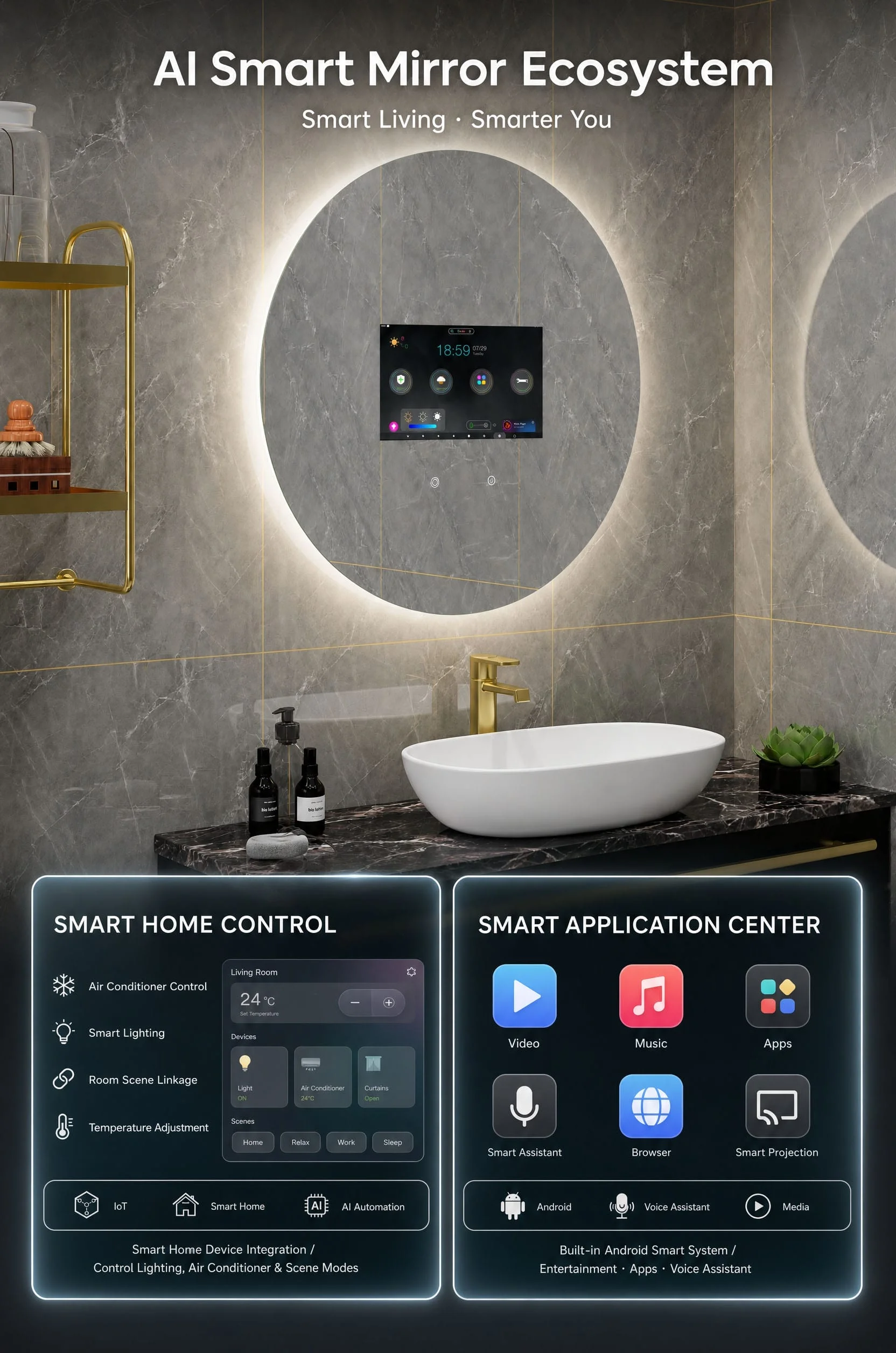
Commercial manufacturers utilize integrating spheres and goniophotometers to measure the absolute luminous flux, chromaticity coordinates, and spectral power distribution of integrated LED assemblies. When sourcing a Bathroom Mirror with integrated lighting, relying on nominal chip-level lumen ratings is insufficient. Bench testing must account for the structural luminaire efficiency, which includes the light loss factor caused by acrylic diffusers, sandblasting patterns, and the internal housing geometry.
The Interplay of CRI, R9, and CCT in Damp Environments
Color rendering index (CRI) measures how accurately a light source reveals the true colors of objects compared to natural daylight.
For hospitality projects, a minimum CRI (Ra) of 90 is recommended, but the critical metric for bathroom vanity applications is the R9 saturated red value. Standard CRI evaluations only average the first eight pastel colors (R1 to R8). Since human skin tones rely heavily on red spectrum rendering, a high R9 value (typically R9 ≥ 50) is essential to prevent a washed-out or greenish complexion. When executing a Bathroom Mirror Customization project, engineers must balance these metrics alongside Correlated Color Temperature (CCT), typically specifying 3000K to 4000K to ensure consistent warm-to-neutral illumination in damp-rated environments.
Lumen per Foot Specs and Diode Density
To achieve seamless illumination without visible dark spots or "hot-spotting" through the glass, manufacturers optimize diode density and spacing.
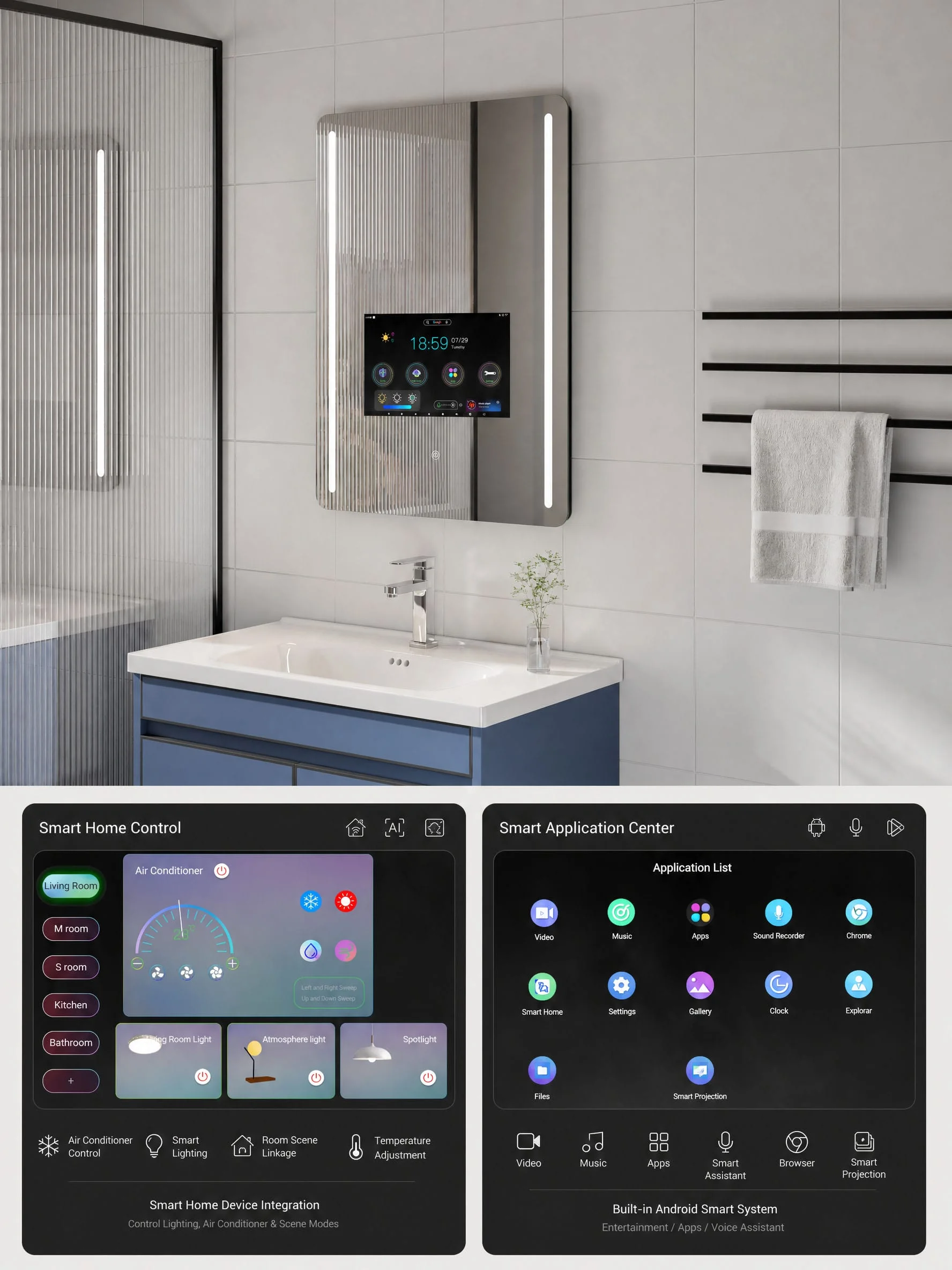
Standard commercial specifications call for high-density LED strips utilizing 120 to 240 diodes per meter. This high density allows the diffuser to blend the light output uniformly. For a classic Frameless Bathroom Mirrors design, the typical standard target is 600 to 1,000 lumens per linear foot of illuminated frosted border. This ensures adequate task lighting for grooming while preventing excessive glare that can cause visual fatigue.
Technical Trade-offs: Driver Lifespan vs. High-Lumen Output
Driving LEDs at their maximum current capacity increases raw lumen output but drastically accelerates thermal degradation and reduces driver lifespan.
To maintain a system life exceeding 50,000 hours, commercial manufacturers run LED chips at 60% to 70% of their maximum rated current. This under-driving strategy keeps junction temperatures low, which is especially critical in enclosed aluminum mirror backboxes where heat dissipation is limited. Sourcing teams should look for Class 2 constant-voltage drivers (typically 24V DC) with built-in over-temperature and short-circuit protection to match the durability expected in commercial facilities.
Mirror Glass Thickness and Light Transmission Performance
The physical composition of the glass mirror substrate directly affects both light transmission efficiency and color shifting.
Standard clear float glass contains iron oxide impurities that cast a subtle green tint. When light travels through a standard 5mm or 6mm mirror border, this green tint can skew a high-CRI light source (e.g., shifting a calibrated 95 CRI down to an effective 88 CRI). For high-end hospitality suites, choosing low-iron glass (such as ultra-white glass) maximizes light transmission and ensures that the spectral accuracy of the LED diodes is preserved precisely as they pass through the sandblasted diffusion window.
Commercial LED Specification Guidelines
| Application Type | Target CRI (Ra / R9) | Lumen Output (per Linear Foot) | Glass Substrate Specification |
|---|---|---|---|
| Hospitality Guestrooms | 90+ CRI / R9 ≥ 50 | 600 - 800 lm/ft | 5mm Low-Iron (Ultra-Clear) |
| Multi-Family Residential | 80+ CRI / R9 ≥ 10 | 500 - 700 lm/ft | 5mm Standard Clear Float |
| Commercial Public Restrooms | 80+ CRI / R9 ≥ 0 | 800 - 1,000 lm/ft | 6mm Standard Clear Float |
| High-End Luxury Suites | 95+ CRI / R9 ≥ 80 | 700 - 900 lm/ft | 6mm Low-Iron (Ultra-Clear) |
Frequently Asked Questions
Q: What is the minimum recommended CRI for lighted mirrors in commercial hospitality projects?
A: For hospitality guestrooms, a minimum of 90 CRI is the industry standard. This ensures accurate color representation for cosmetics application and grooming, which directly impacts guest satisfaction.
Q: How does high CRI affect the required lumen output in LED bathroom mirrors?
A: High-CRI LED chips (especially 90+ and 95+ options) typically exhibit lower luminous efficacy (lumens per watt) compared to low-CRI chips because more phosphor is required to convert blue light into a broader, more balanced spectrum. To maintain the targeted lumen output, manufacturers must increase the input wattage or use higher-efficiency LED architectures.
Q: What are the standard lumen per foot specs for wholesale backlit vanity mirrors?
A: The standard is 600 to 1,000 lumens per linear foot. This range provides a balanced output that is bright enough to serve as effective auxiliary task lighting without causing glare when viewed directly.
Q: How do wholesale manufacturers balance driver lifespan with high-lumen output?
A: Manufacturers achieve this by under-driving high-power LED chips (running them at 60-70% capacity) and integrating premium thermal management within the aluminum housing. This prevents heat buildup, protecting both the LED diodes and the constant-voltage driver from premature failure.
Q: How does mirror glass thickness affect the perceived color rendering index of integrated LEDs?
A: Standard float glass contains iron, which introduces a green tint that absorbs red and blue light wavelengths. This filtration effect can degrade the perceived CRI of the emitted light. Specifying low-iron glass mitigates this color shift, preserving the high CRI and R9 values of the integrated LEDs.