 Nederlands
 Deutsch
 Español
  Français
 Русский
OEM/ODM Procurement Guide: Sourcing High-Quality Backlit Bathroom Mirrors from Chinese Manufacturers
Sourcing high-quality backlit LED mirrors for hospitality, commercial development, or high-volume distribution requires a deep understanding of manufacturing specifications and quality control metrics. While aesthetic choices are prominent in retail markets, B2B procurement professionals must focus on the underlying engineering, structural integrity, and electronic safety standards that ensure long-term durability. This guide provides an analytical engineering approach to evaluating Chinese OEM/ODM suppliers to secure reliable, compliant, and premium-grade products.
1. Technical Evaluation of Glass and Silvering Processes
The foundation of any commercial-grade Bathroom Mirror is the raw glass substrate and its subsequent silvering process. Standard residential mirrors often utilize copper-based backing layers that are highly susceptible to oxidation, resulting in black-edge corrosion when exposed to humid bathroom environments. For professional projects, procurement managers must insist on 5mm copper-free silver mirrors with an anti-corrosion protective coating.
Copper-free mirrors exhibit superior resistance to atmospheric humidity, salt, and acidic cleaning agents. The silvering process should include a multi-layer protective film, consisting of a silver layer, a passivation film, and a dual-layer waterproof base paint. When choosing a Frameless Bathroom Mirrors design, the exposed edges must be CNC-polished to seal the microscopic silvering margins, preventing moisture ingress from initiating delamination.
2. LED Strip Quality and Driver Engineering
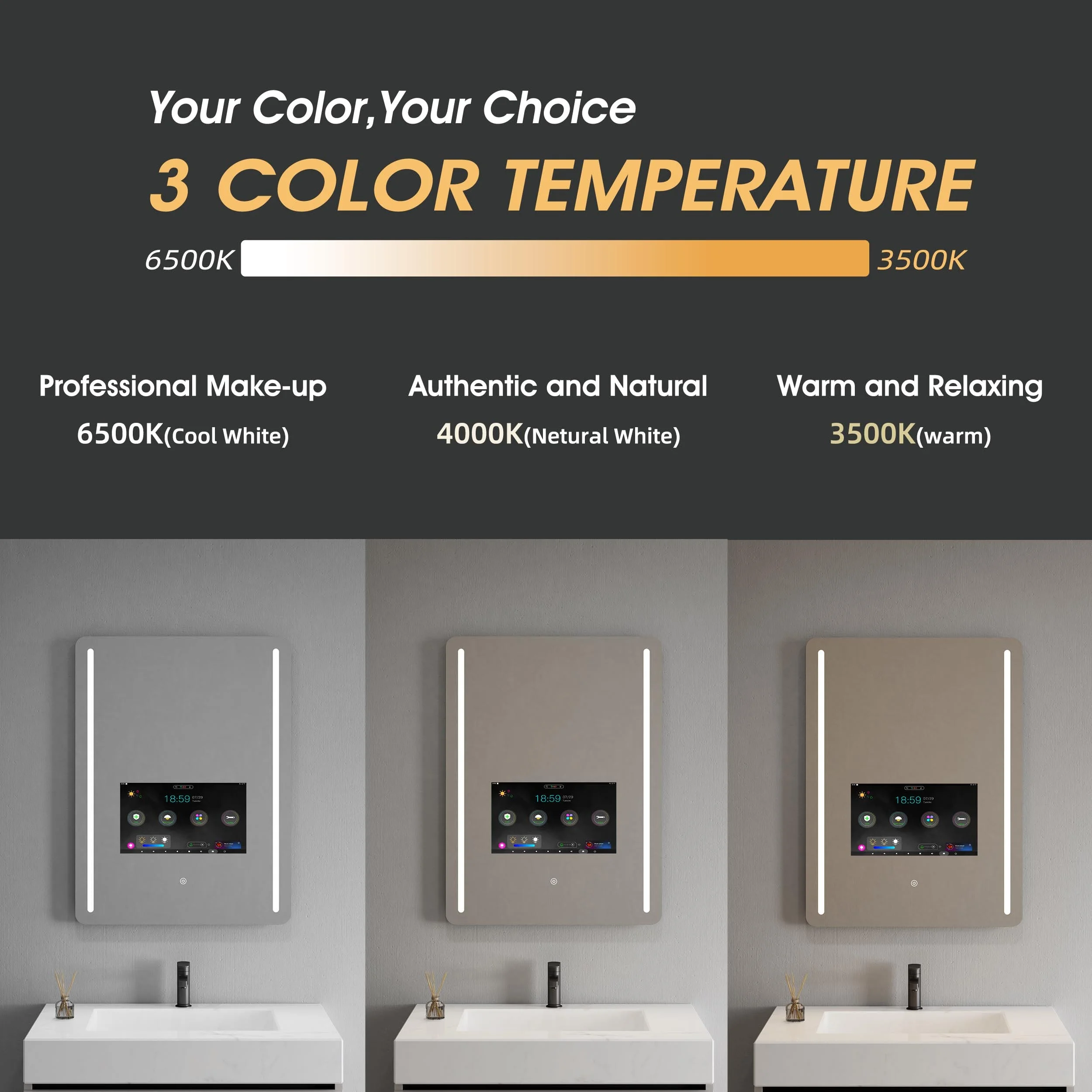
The lifetime and color consistency of backlit mirrors depend entirely on the light-emitting diodes (LEDs) and their integrated drivers. High-end hospitality installations require LEDs with a high Color Rendering Index (CRI) of Ra > 90, with specific attention paid to the R9 value (red color rendering) to ensure natural skin tones. Furthermore, color temperature consistency must be maintained within a tight MacAdam Ellipse (SDCM < 3) across manufacturing batches to prevent visible color variation between adjacent installations.
The electronic driver is the most common point of failure in an active smart mirror system. Reliable Chinese ODM manufacturers partner with globally recognized driver brands such as Mean Well, Lifud, or EagleRise. These drivers must feature integrated over-voltage, over-current, and short-circuit protection, as well as an active power factor correction (PFC > 0.9). For advanced smart installations, such as an Ai Tv Bathroom Mirror, isolating the processing hardware power supply from the LED driver circuit is crucial to prevent electromagnetic interference.
3. Internal Chassis Engineering and Heat Dissipation
Effective thermal management is essential to prevent LED degradation over time. High-quality backlit mirrors feature an integrated aluminum alloy back chassis that serves a dual purpose: providing structural rigidity and acting as an efficient heat sink. Cheap alternatives often utilize PVC or plastic backing plates, which trap heat and accelerate light decay, reducing the LED lifespan from 50,000 hours to less than 15,000 hours.
The internal chassis must be designed to accommodate both the LED strips and auxiliary functional components like defogger pads. Defogger heating elements should be constructed from PET high-temperature resistant heating films rather than low-cost PVC films, ensuring uniform heat distribution and a standard surface heating power of 1.5 to 2.5 Watts per square decimeter. The placement of these components should leave sufficient space within the metal chassis to maintain low operating temperatures for the central electronics.
4. Comparing OEM vs. ODM Manufacturing Capabilities
When initiating Bathroom Mirror Customization projects, understanding the technical differences between basic OEM assembly and advanced ODM engineering is critical. Below is a comprehensive engineering comparison table to guide your sourcing strategy:
td style="padding:8px 14px;border-bottom:1px solid #e5e7eb;vertical-align:top">50 - 100 units depending on custom structural tooling.td style="padding:8px 14px;border-bottom:1px solid #e5e7eb;vertical-align:top">Custom spectrum tuning (Ra > 95, R9 > 90, tunable white).td style="padding:8px 14px;border-bottom:1px solid #e5e7eb;vertical-align:top">Full fixture UL, ETL, CE, RoHS, and SAA certification.| Feature / Metric | Standard OEM Contract Manufacturing | Advanced ODM Engineering Service |
|---|---|---|
| Engineering Input | Client provides completed 2D/3D CAD blueprints. | Factory co-develops concepts based on technical parameters. |
| Typical MOQ Requirements | 100 - 200 units per standard SKU. | |
| Ingress Protection (IP) Rating | IP44 standard moisture-resistant enclosures. | IP44 to IP67 custom sealed electronic compartments. |
| CRI & Color Rendering | Standard Ra > 80 or Ra > 90 standard strips. | |
| Safety Certification Compliance | Pre-certified standard driver components. |
5. Packaging Engineering and Container Transit Protocols
Even the highest-quality backlit mirrors can turn into commercial losses if the packaging cannot withstand sea freight transit. Large-scale mirror distribution demands drop-tested packaging that conforms to international standards like ISTA 1A or ISTA 3A. The packaging assembly should feature high-density molded expandable polystyrene (EPS) or polyethylene (EPE) foam corners surrounding the entire perimeter of the mirror.
To prevent localized pressure points from causing glass breakage inside shipping containers, mirrors should be packed vertically in double-wall corrugated cardboard master cartons. For FCL (Full Container Load) shipments, pallets must be securely wrapped with stretch film and stabilized with heavy-duty corner boards. When coordinating LCL (Less than Container Load) shipping, custom wooden crates or plywood outer skeletons are highly recommended to prevent handling damages by third-party logistics providers.
6. Crucial Quality Assurance and Factory Audit Protocols
Before placing a deposit, B2B buyers should request documented evidence of specific factory quality control (QC) procedures. A reliable backlit mirror manufacturer must have an on-site testing facility capable of executing a series of specialized diagnostic evaluations. Foremost among these is the High-Voltage Safety Test (Hi-Pot test) conducted on 100% of the active mirror assembly lines to ensure zero current leakage from the high-voltage input to the metal chassis.
Furthermore, ask for salt spray testing reports (typically ASTM B117 standards) to verify the corrosion resistance of the silver backing layer and any structural metal framing. Other crucial on-site tests include integrating sphere testing to measure luminous flux, color temperature (CCT), and CRI of the LED strips, as well as IPX4/IPX5 water-spray chambers to prove the integrity of the rear electrical enclosures. Partnering with a supplier who maintains these verification standards guarantees a robust, long-lasting product portfolio.
Frequently Asked Questions
Q: How do Chinese mirror manufacturers handle IP44 or IP67 waterproofing for backlit LED mirrors?
A: Reliable manufacturers achieve IP44 ratings by enclosing all electrical components—such as drivers, touch sensors, and defogger junctions—inside a sealed, gasket-lined rear plastic or aluminum junction box. For high-humidity or wet areas requiring IP67 ratings, manufacturers potting the LED strips in silicone sleeves and fully encase the electronic power drivers in waterproof epoxy resin to prevent any moisture ingress.
Q: What are the typical MOQ requirements for custom ODM backlit bathroom mirrors?
A: Minimum Order Quantities (MOQ) for fully customized ODM projects generally range from 50 to 100 units per size, depending on the complexity of the custom aluminum chassis or unique glass cuts. For standard catalog configurations with basic OEM branding, manufacturers can often accept lower MOQs starting at 20 to 50 units per SKU, provided the order meets a viable total shipping volume.
Q: How do we verify the quality and longevity of LED strips and drivers used by suppliers?
A: B2B buyers should request official LM-80 test reports for the LED chips, which document light decay over time, and verify that the power drivers carry legitimate regional certifications (such as UL/ETL for North America, CE/TUV for Europe). Additionally, request the factory to provide integrating sphere test results showing the exact CRI (Ra and R9) and color temperature stability across production runs.
Q: What is the standard glass thickness and silvering process for commercial projects?
A: The standard for commercial projects is 5mm thick copper-free glass. The silvering process must involve applying a layer of high-purity silver followed by a passivation layer, a copper-free protective barrier, and two coats of waterproof protective base paint to ensure the mirror is completely resistant to silver oxidation and edge blackening.
Q: How do manufacturers package bulk LED mirrors to prevent breakage during sea freight container transit?
A: Factories package commercial shipments using heavy-duty drop-tested cartons containing custom-molded high-density EPE foam corner protectors. Cartons are loaded onto pallets vertically, secured with polyester strapping and stretch wrap, and reinforced with sturdy vertical corner boards to withstand transit shocks and shifts inside the container.





