 Nederlands
 Deutsch
 Español
  Français
 Русский
Supply Chain Optimization for Importing Hollywood Mirrors with Lights in High-Volume Batches
Sourcing and importing high-volume batches of professional lighted mirrors requires a rigorous focus on technical compliance, structural engineering, and freight optimization. Standard consumer-grade shipping models fail to address the critical logistical risks, structural load limitations, and customs clearance requirements inherent in commercial mirror distribution. By analyzing the engineering constraints of large-format glass and aligning production schedules with international transit protocols, B2B procurement managers can drastically reduce transit damage, eliminate regulatory compliance delays, and lower landing costs.
Structural Integrity and Technical Specifications of Bulk Mirrors
When engineering high-volume batches, structural integrity must be validated before mass glass cutting begins. From manufacturing thousands of units on our automated production lines, we have found that utilizing a minimum of 5mm thick copper-free silver glass is essential to prevent bowing or warping over large surfaces. In contrast to standard 3mm glass, which flexes under minor pressure, a 5mm tempered glass backplane provides up to 5 times the impact resistance, ensuring structural stability during sea freight movement.
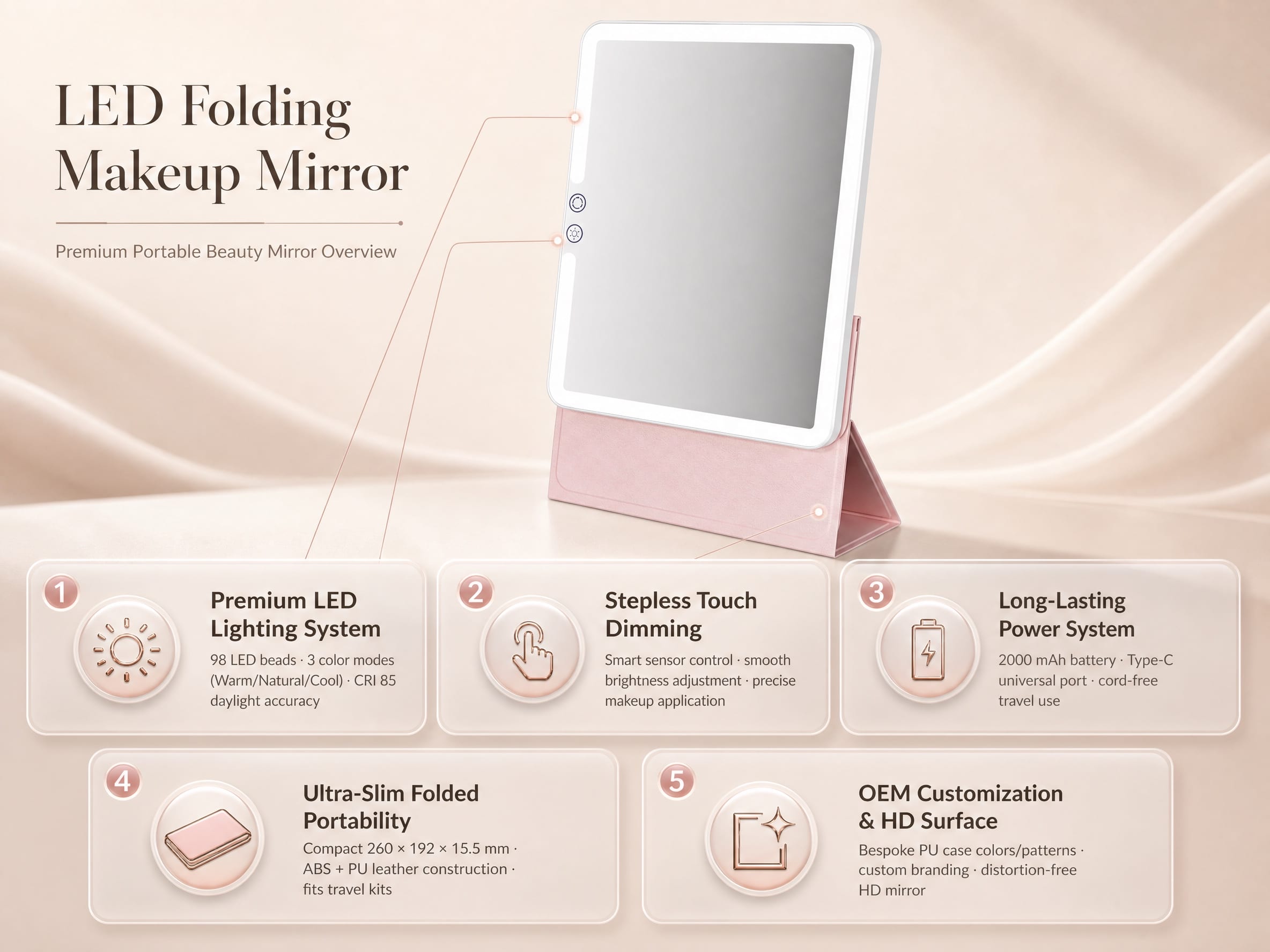
Technical performance also relies heavily on the quality of internal electronic components. For our flagship commercial models, such as the premium Large Hollywood Mirror, we specify LED light engines with a Color Rendering Index (CRI) of Ra ≥ 90 to meet retail and professional beauty requirements. Thermal management is controlled via an integrated 1.5mm extruded aluminum backing plate that serves as a heat sink, ensuring the operating temperature of the embedded LED driver remains below 65°C, which dramatically extends the operational lifespan of the luminaire.
Electrical Compliance and Global Certification Standards
Navigating cross-border customs requires strict compliance with localized electrical standards. High-volume batches destined for North America must strictly conform to UL 2108 (Low Voltage Lighting Systems) or UL 1598 (Luminaires), depending on the driver configuration. For European markets, CE-LVD and CE-EMC compliance are mandatory. During third-party factory audits conducted by global inspection bodies like TÜV Rheinland or SGS, every electrical sub-assembly is subjected to a 3,000V high-voltage (Hi-Pot) dielectric strength test to guarantee zero insulation leakage before final packaging.
Furthermore, sourcing teams must verify that the LED driver chips comply with FCC Part 15 Class B for electromagnetic interference in residential or commercial settings. Integrating certified drivers prevents custom clearance delays and mitigates the risk of distributor product recalls. When executing Hollywood Mirror Customization projects, we provide complete, traceable UL/CE certificates and test reports for each specific batch model configuration prior to export booking.
Packaging Engineering and Transit Damage Mitigation
The primary financial risk when importing large glass products is transit breakage. Standard retail boxes are insufficient for long-haul sea freight. Our production facility employs rigorous packaging protocols modeled after the ISTA 6-Amazon.com drop test standard. Each unit is encased in 360-degree high-density molded polyethylene (EPE) foam with a minimum thickness of 50mm, protecting the delicate glass surface and the bulb sockets from high-frequency vibration during container transport.
For high-volume distribution, individual cartons are packed into double-wall master cartons (BC-flute corrugated cardboard, burst strength exceeding 250 lbs per square inch). For bulk shipments of a Hollywood Mirror, we construct heavy-duty plywood pallets rather than softwood pallets to prevent structural shifting. These pallets are wrapped in multi-layer stretch film with corner protectors and strapped securely to avoid any glass flexing when maritime containers experience lateral forces in rough seas.
Container Utilization and Logistics Optimization
To maximize your return on investment, optimizing container utilization is critical. Flat-packed illuminated mirrors require precise volumetric calculations to avoid dead space while maintaining necessary foam padding buffers. In a standard 40-foot High Cube (40' HC) container, total volume capacity is approximately 76 cubic meters, but because of glass weight limits and protective packaging, structural loading must be planned using 3D container-loading software to distribute weight evenly across the container floor.
| Mirror Classification / Category | Standard Dimensions (mm) | Packaging Volume per Unit (CBM) | Estimated Capacity (40' HC) | Compliance Certifications |
|---|---|---|---|---|
| Tabletop Hollywood Mirror | 500 x 400 x 100 | 0.045 | 1,400 to 1,500 units | CE, RoHS, UL 2108 |
| Medium Wall-Mounted Mirror | 800 x 600 x 60 | 0.085 | 750 to 800 units | UL 1598, FCC, CE |
| Full-Length Framed Mirror | 1600 x 600 x 80 | 0.192 | 300 to 330 units | UL, CE, IP44 Rated |
By executing custom calculations per shipment batch, importers can avoid under-utilization charges. For heavy structural glass models like the Hollywood Full Length Mirror, we advise clients to balance the weight limitations of local destination port transport laws against total container volume to optimize pricing per unit during sea freight shipping.
Quality Assurance and AQL Limits for Bulk Manufacturing
In high-volume manufacturing, standardizing quality thresholds is the most effective way to eliminate disputes over defects. We apply the global ISO 2859-1 sampling plan, setting strict Acceptable Quality Limit (AQL) boundaries before any shipment leaves the warehouse. For structural integrity and safety elements, we enforce an AQL of 0 (Critical Defects); for operational components such as LED color rendering, dimming drivers, or touch sensors, the limit is set to AQL 1.5 (Major Defects); and cosmetic glass blemishes are capped at AQL 4.0 (Minor Defects).
During the mass assembly process, QC checks are integrated directly at the end of the LED solder line, immediately post-CNC glass cutting, and at the 24-hour constant power burning-in test station. This rigorous quality management ensures that high-volume distributors do not absorb the cost of field failures. Implementing standardized inspection criteria gives B2B buyers the assurance that bulk shipments will arrive ready for immediate distribution, commercial installation, or high-end retail display.
Frequently Asked Questions
Q: What is the standard lead time for manufacturing a bulk batch of 1,000 LED Hollywood mirrors?
A: The standard manufacturing lead time for high-volume orders is typically 35 to 45 days. This allows for glass tempering, CNC silvering, custom aluminum framing, and a mandatory 24-hour electronic burn-in safety test for all completed units prior to packaging.
Q: How does your factory guarantee electrical safety compliance for different destination countries?
A: We configure and assemble electrical systems specifically tailored to destination market standards. Shipments to North America feature UL-certified low-voltage drivers (UL 2108), while European orders utilize CE-marked, RoHS-compliant components with IP44 ingress protection where required.
Q: Can we integrate smart features like Bluetooth into high-volume customized batches?
A: Yes, smart features are fully customizable. We frequently design and assemble the Bluetooth Hollywood Mirror in bulk, integrating dual-channel stereo speakers and custom touch screens directly behind the silvered glass panel while maintaining low-voltage electrical isolation.
Q: How are shipping containers structured to prevent glass damage during transit?
A: Mirrors are stacked vertically on customized heavy-duty plywood pallets rather than laid flat, preventing downward structural strain. Heavy straps, structural corner blocks, and anti-vibration high-density EPE foam barriers inside individual boxes prevent movement within the sea container.
Q: What is the policy for handle-damage claims or glass breakage during sea freight?
A: We operate under a transparent warranty policy with predefined AQL thresholds. If any glass breaks due to packaging defects during transport, we replace those units or credit the equivalent value in the subsequent container batch, supported by unloading inspection reports and photographic proof.





